CAN Bus Servo Motors
CAN bus servo motors are closed-loop actuators that receive position, velocity and torque commands over a shared CAN 2.0A/B bus and return position, current, temperature and fault codes. Each servo carries its own node ID, so dozens of axes run on two twisted wires with deterministic timing and high immunity to electrical noise.
Where CAN bus servos earn their cost
- AGV and AMR steering and drive axes
- Quadruped and humanoid robot joints
- Robotic arms with six or more axes on one cable run
- Agricultural, construction and automotive test rigs
Typical CAN bus servo specifications
| Bus | CAN 2.0A/B, 11-bit or 29-bit identifiers |
| Higher-layer protocol | CANopen CiA 301 / CiA 402 drive profile (optional) |
| Baud rate | 125 kbps – 1 Mbps |
| Nodes per bus | 64–110 typical, hardware dependent |
| Torque range | 5–400+ kg·cm (0.5–39+ N·m) |
| Supply voltage | 12–72 V DC |
| Feedback | 12–17 bit absolute encoder, current, temperature, error flags |
| Termination | 120 Ω at both ends of the trunk |
CAN bus vs RS-485 vs TTL
CAN is multi-master with hardware arbitration and a CRC on every frame, which is why it wins when you have many axes, high loop rates or heavy EMI. RS-485 with Modbus RTU is simpler and reaches 1,200 m, making it the default in PLC-led plants. TTL serial is board-level and shortest range.
What to confirm before ordering
Check three things: the node ID range and whether the firmware speaks CANopen, the bus baud rate your master runs today, and whether position is retained as absolute after a power cycle. For battery-powered AGVs, also ask for standby current — it usually decides runtime more than torque does.
FAQ
Do I need CANopen or raw CAN?
Choose CANopen CiA 402 if you are integrating with a standard motion controller or PLC that already speaks the drive profile. Raw CAN is fine for a custom embedded master with a fixed frame map.
How many servos can share one CAN bus?
2,048 identifiers exist in theory; in practice 64–110 nodes per segment, limited by bus load, cable length and power distribution. Split into segments with a bridge above that.
Why do I need 120 Ω terminators?
Without termination at both ends, signal reflections corrupt frames at 1 Mbps and produce intermittent bus-off errors that look like firmware bugs.
Related: RS-485 / Modbus servo motors · 130–400 kg·cm servos · 400+ kg·cm high-torque servos
Showing 1–12 of 14 results
-
130–400 kg·cm Servo Motors
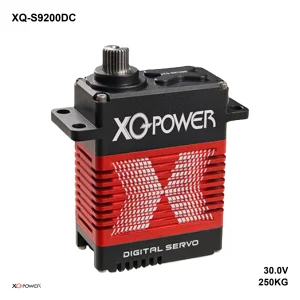
Industrial Brushless Servo S9200DC 250kg (24.5 N·m) 30V 405g CAN
Read more -
60–130 kg·cm Servo Motors
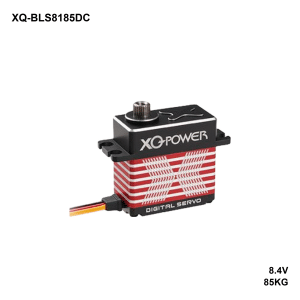
Heavy Duty Brushless Servo BLS8185DC 85kg (8.3 N·m) 8.4V 92g CAN
Read more -
60–130 kg·cm Servo Motors
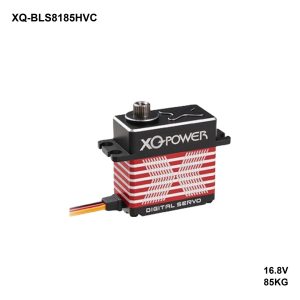
Heavy Duty Brushless Servo BLS8185HVC 85kg (8.3 N·m) 16.8V 92g CAN
Read more -
60–130 kg·cm Servo Motors
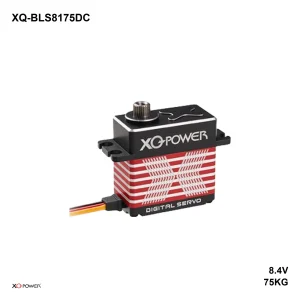
High Torque Brushless Servo BLS8175DC 75kg (7.4 N·m) 8.4V 88g CAN
Read more -
20–60 kg·cm Servo Motors
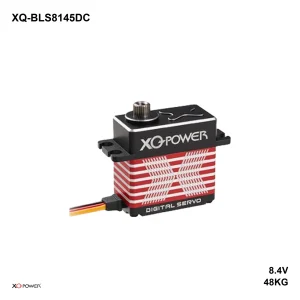
High Torque Brushless Servo BLS8145DC 48kg (4.7 N·m) 8.4V 73g CAN
Read more