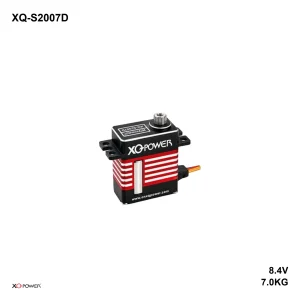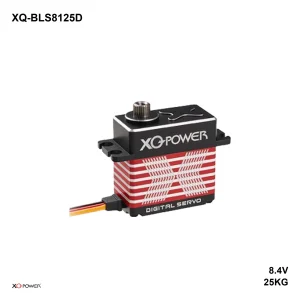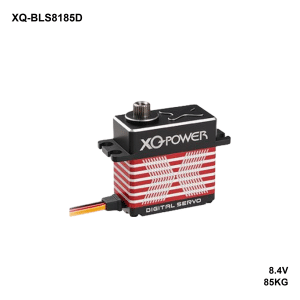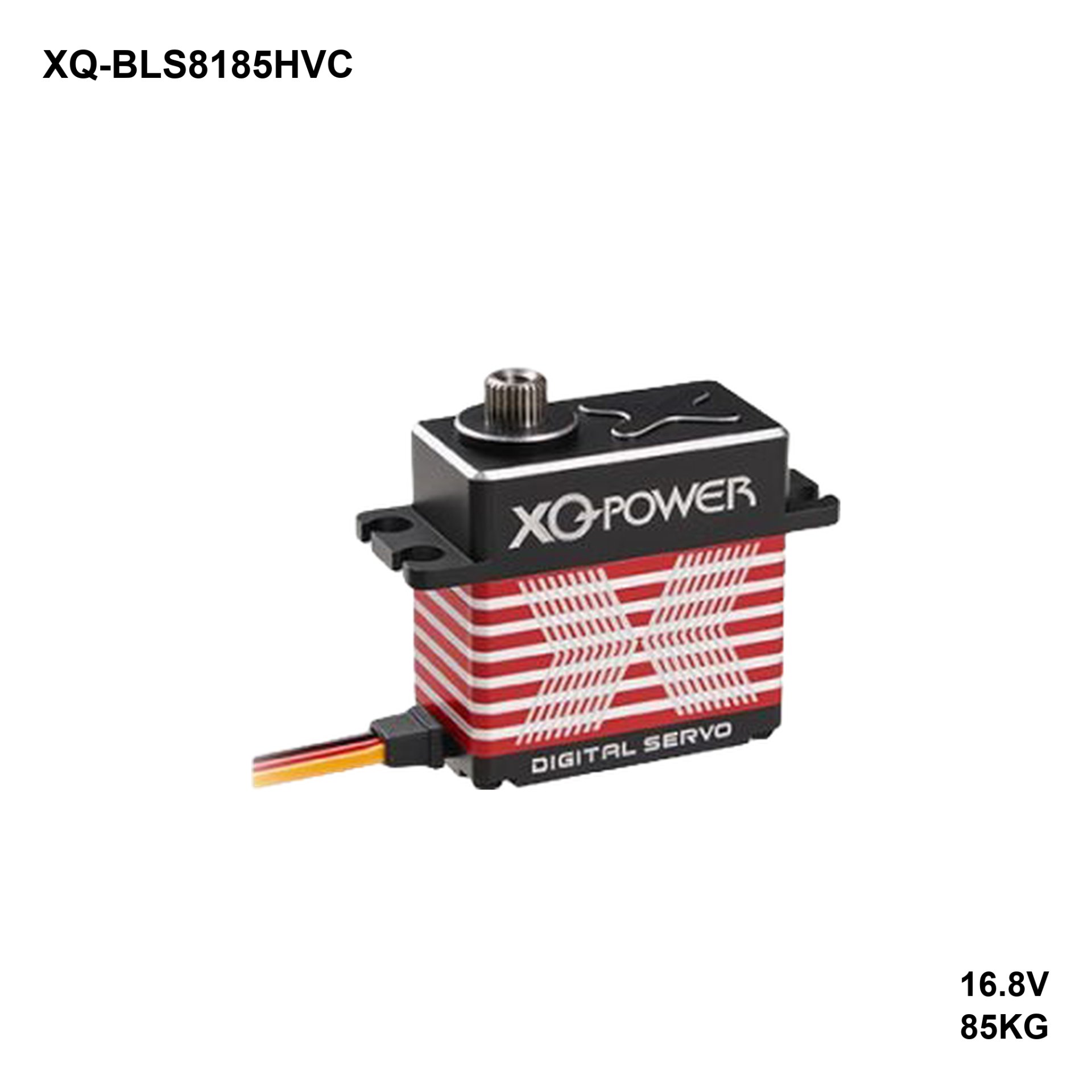
XQ-BLS8185HVC — 85 kg·cm (8.3 N·m) on a 4S rail as a CAN node, for joints that move together A brushless motor drives a stainless steel train onto a 25T, φ7.96 mm output carried in two ball bearings, inside a 40 × 20 × 44 mm machined aluminium case at 92 g. The winding is set for a 4S pack: the unit peaks on 16.8 V where the 2S build of this frame peaks on 8.4 V.
The unit gives 42 kg·cm on 8.4 V, 60 kg·cm on 12.0 V and 85 kg·cm on 16.8 V, with speed and current at all three rails. Rated and tested to inspection sheet X8_8185.01, dated 2025-07-01.
| Peak stall torque85 kg·cmat 16.8 V · 1180.4 oz-in · 8.3 N·m | Speed0.11 s/60°at 16.8 V · 0.17 s at 8.4 V | Supply8.4–16.8 Vthree published points |
| ControlCANCAN bus · 360° on the command scale | Envelope40 × 20 × 44 mm54.0 mm across the ears · 25T-φ7.96 | Mass92 g2 ball bearings · no mechanical stop |
Is the XQ-BLS8185HVC the right servo for your joint?
A 4S machine with more than one heavy joint is where this build belongs. The winding puts 85 kg·cm on the 16.8 V rail, and the CAN input lets the master address each joint, schedule the frames and keep a pair of surfaces in a relationship that a set of separate pulse outputs cannot hold.
The mechanics are the frame parts: two bearings on a φ7.96 mm output, ears cut into a 20 mm case, 360° across the 1000–2000 µs span, no stop inside. Section 5-1 names CAN as the command signal and the position figures stay on the scale the pulse build uses.
Specify this unit when
- The machine runs a 4S pack and a CAN bus the master addresses
- Two or more joints have to hold a relationship in time
- The joint needs about 85 kg·cm at 16.8 V
- The pocket is 20 mm deep and 44 mm tall
- The harness can be built to the connector on the unit
Specify a different unit when
- The controller has no CAN port and no gateway in front of it
- The machine runs a 2S pack, where this build gives 42 kg·cm
- The joint relies on an internal stop for its end positions
- The arm carries its load a long way out from the spline
- The bay cannot take 54 mm across the ears
Torque and speed at 8.4, 12.0 and 16.8 Volts
Locked-shaft torque, no-load speed, no-load current and stall current from rows 4-1 to 4-13. Read the left column against the pack in the machine: the same joint gives 42 kg·cm on a 2S rail.
| Supply | Peak stall torque | No-load speed | No-load current | Stall current |
|---|---|---|---|---|
| 8.4 V | 42.0 kg·cm | 0.17 s/60° | 320 mA | 4.0 A |
| 12.0 V | 60.0 kg·cm | 0.14 s/60° | 370 mA | 5.0 A |
| 16.8 V | 85.0 kg·cm | 0.11 s/60° | 440 mA | 6.0 A |
85 kg·cm at 16.8 V with 0.11 s per 60°, 60 kg·cm at 12.0 V, 42 kg·cm at 8.4 V. The whole spread lives between the rails, so the pack is part of the joint specification: a 4S pack that sags to 13 V under load hands the joint the 12 V column at 60 kg·cm.
Stall current is 4.0 A at 8.4 V, 5 A at 12.0 V and 6.0 A at 16.8 V, against 320 to 440 mA at no load. The 300 mm lead carries all of it, and on a 4S machine the supply and the connector are the parts that decide whether the joint ever sees 16.8 V under load.
Fit: envelope, spline and mass
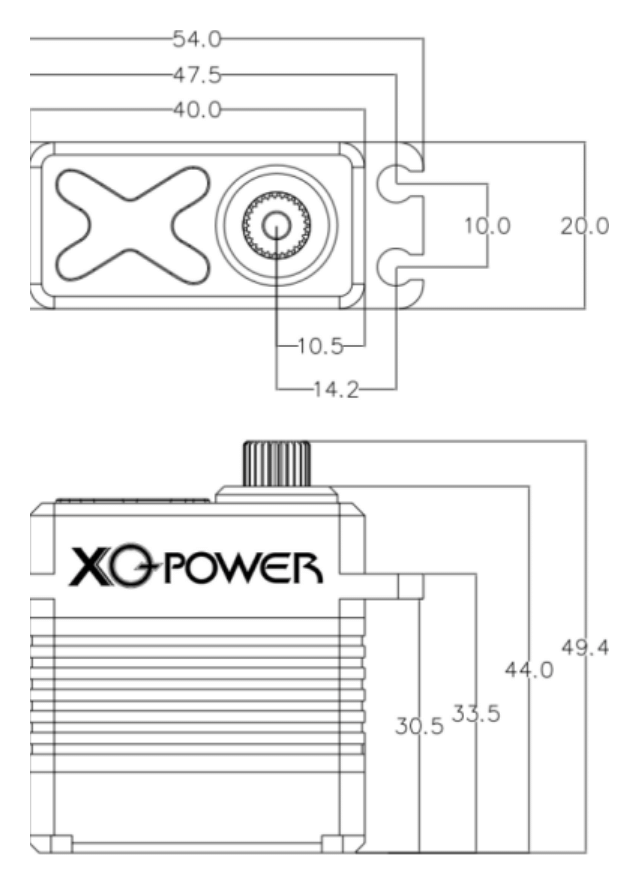
40 × 20 × 44 mm, 54.0 mm across the mounting ears, 49.4 mm to the top of the spline. Same envelope as the 2S build of this frame, so a pocket cut for one takes the other: measure from the ear face, because the mounting face sits at the top of the fins.
25T at φ7.96 mm with a 7075 aluminium arm in the box. This is the spline the 25, 45, 75 and 85 kg·cm frames of the series share, so an arm cut for any of them seats here.
92 g with the arm. The high-voltage winding does not add mass: the difference between this build and the 2S one is copper and turns.
Drive, current and heat
6.0 A at stall on 16.8 V and 440 mA at no load. The current is the same figure the 2S build reaches at 8.4 V, so the lead and the connector are sized the same way; what changes is the voltage the insulation and the supply have to hold.
Dead band 2 µs, neutral 1500 µs, window 800–2200 µs, all marked customizable. That 2 µs band is tighter than the 3 µs on the 9-series frames, which matters on a linkage that has to hold a position against a spring.
The case is a machined block with fins over the motor section, and the drive sits against them. A joint holding a load against gravity with the arm stationary pulls near stall current and has only the fins and the bracket to shed the heat.
Two bearings carry the torque at 85 kg·cm without trouble. They do not resist a bending moment, so keep the load close to the spline or support the far end of the arm.
Sealing and environment
Section 3-11 records splash resistance as Yes on a machined aluminium case with sealed joint faces. A higher water-protection grade is built to order, with the class and the test standard agreed at order stage.
The lead leaves through a sealed exit at the base of the case and the connector on its end sits outside that seal. Keep the plug dry or seal it to the same standard, and dress the lead downward from the exit.
We rate the unit −15 ℃ to 65 ℃ operating and −20 ℃ to 70 ℃ storage. The cold end is narrower than the 9-series frames carry, so a machine that works outdoors in winter should check it before the joint is specified.
Full specification
The complete sheet for the XQ-BLS8185HVC, in the order it appears on inspection document X8_8185.01, dated 2025-07-01: measured figures throughout, and where we have none the row says so.
| Model | XQ-BLS8185HVC |
| Peak stall torque (SI) | 8.3 N·m at 16.8 V |
| Voltage range | 8.4–16.8 V |
| Control interface | CAN bus |
| Amplifier | Digital controller |
| Rotating direction | CCW (1000–2000 µs), customizable |
| Angle of limit | None, no mechanical stop |
| Motor | Brushless |
| Gear train | Stainless steel |
| Bearing system | 2 ball bearings |
| Output spline | 25T, φ7.96 mm |
| Horn supplied | 7075 aluminium CNC arm supplied |
| Case | Aluminium CNC, all-metal case |
| Dimensions | 40 × 20 × 44 mm |
| Weight | 92 g |
| Cable length | 300 mm lead fitted |
| Operating temperature | −15 ℃ to 65 ℃ |
| Storage temperature | −20 ℃ to 70 ℃ |
| Sealing | Splash-proof · higher water-protection grade built to order |
| Specification revision | X8_8185.01, dated 2025-07-01 |
Download the XQ-BLS8185HVC datasheet (PDF)
The inspection sheet for this model, including the dimensional drawing and the control-signal table, is available as a PDF.
|
XQ-BLS8185HVC inspection specification Revision X8_8185.01 · dated 2025-07-01 · PDF |
Download PDF |
If you need the drawing in DWG, a STEP model, or the control-signal table as a separate sheet, tell us which format your CAD system uses and we will send that instead.
Variants, samples and OEM work
The CAN build on the 2S winding is BLS8185DC, and the pulse and RS485 builds of this winding are BLS8185HV and RS8185HV. The 75 kg·cm CAN frame at 8.4 V is BLS8175D.
Three input stages share this winding, and all of them use the same ears, arm and travel figures. The choice comes down to what the controller speaks; the torque curve stays where the sheet puts it.
For OEM and ODM work on the XQ-BLS8185HVC we start from five numbers: the torque you need at your speed, the supply you actually run, the interface your controller speaks, the envelope the joint allows, and the duty cycle. Send those and we answer one of three ways — the XQ-BLS8185HVC covers it as stock at 85 kg·cm, a build of the same 40 × 20 × 44 mm frame does, or the axis needs a different frame. Send the XQ-BLS8185HVC numbers to the engineering team.
Quick facts and cross-reference
The rows below are what to quote for the XQ-BLS8185HVC: 85 kg·cm (8.3 N·m) on 8.4–16.8 V with CAN input, plus the two makes buyers usually weigh it against.
| Model | XQ-BLS8185HVC |
| Peak stall torque | 85 kg·cm · 8.3 N·m at 16.8 V |
| Voltage range | 8.4–16.8 V |
| Control interface | CAN bus |
| Speed | 0.11 s/60° |
| Mass / envelope | 92 g · 40 × 20 × 44 mm |
| Also described as | CAN bus servo, CAN actuator, CANopen servo, robot joint actuator |
Buyers often arrive here from a Hitec D980TW or a Feetech FT5335M, which are built around 6.0-8.4 V receiver rails with PWM input; the XQ-BLS8185HVC is 85 kg·cm (8.3 N·m) on 8.4–16.8 V, so put the two on the same rail and in the same unit before comparing torque.
| Cross-reference | Hitec D980TW, Feetech FT5335M |
| Their typical rail | built around 6.0-8.4 V receiver rails with PWM input |
| This model | 85 kg·cm (8.3 N·m) on 8.4–16.8 V, CAN input |
FAQ
What is the difference between the HV build and the 8.4 V build of this frame?
The winding. The case, the 25T φ7.96 mm output, the two bearings, the arm and the 360° figure are the same parts. This build peaks at 85 kg·cm on 16.8 V; the 8.4 V build peaks at 85 kg·cm on 8.4 V and gives 42 kg·cm if you put 8.4 V into this one. Choose by the pack in the machine.
Does it have a mechanical stop?
No. Section 3-4 reads No Limit and 5-5 gives 360° across the 1000–2000 µs span. The machine provides the end positions, and at 85 kg·cm a joint driven into a hard stop damages the linkage.
How much current does it draw?
4.0 A at 8.4 V stall, 5 A at 12.0 V and 6.0 A at 16.8 V, with 320 to 440 mA at no load. Size the supply, the switch and the connector on the 6 A figure at the rail you run.
Can I run it on 5S?
Section 4-1 to 4-13 give three working points and 16.8 V is the top of them. We do not publish a figure above that, so a 5S pack is outside what this sheet supports; tell us the rail and we will say what we can offer.
What bus settings does it ship with?
Section 5-1 names CAN as the command signal. Baud rate, node identifier and frame layout are set at order stage against your master, written into the protocol note that ships with the unit, and confirmed in writing before the order is accepted.
How many joints can one bus carry?
The limit is the transceiver at the master and the traffic the machine already carries. Two or three of these on one pair is an ordinary arrangement; tell us the count and the update rate and we will confirm the line settings against it.
Is the XQ-BLS8185HVC a drop-in replacement for a Hitec D980TW?
No. The Hitec D980TW runs on a different rail and a different frame, while the XQ-BLS8185HVC is 85 kg·cm (8.3 N·m) on 8.4–16.8 V with CAN input, so a swap means checking voltage, envelope and travel first. Send the rail and envelope your machine runs and we will say whether the XQ-BLS8185HVC frame fits.
What should I compare before choosing between the XQ-BLS8185HVC and a Feetech FT5335M?
Four numbers decide between the XQ-BLS8185HVC and a Feetech FT5335M: peak stall torque in N·m, the rail you actually run, stall current, and whether your controller speaks CAN. The XQ-BLS8185HVC publishes 85 kg·cm (8.3 N·m) on 8.4–16.8 V; put the Feetech FT5335M on that same rail and in the same unit before you compare the two.