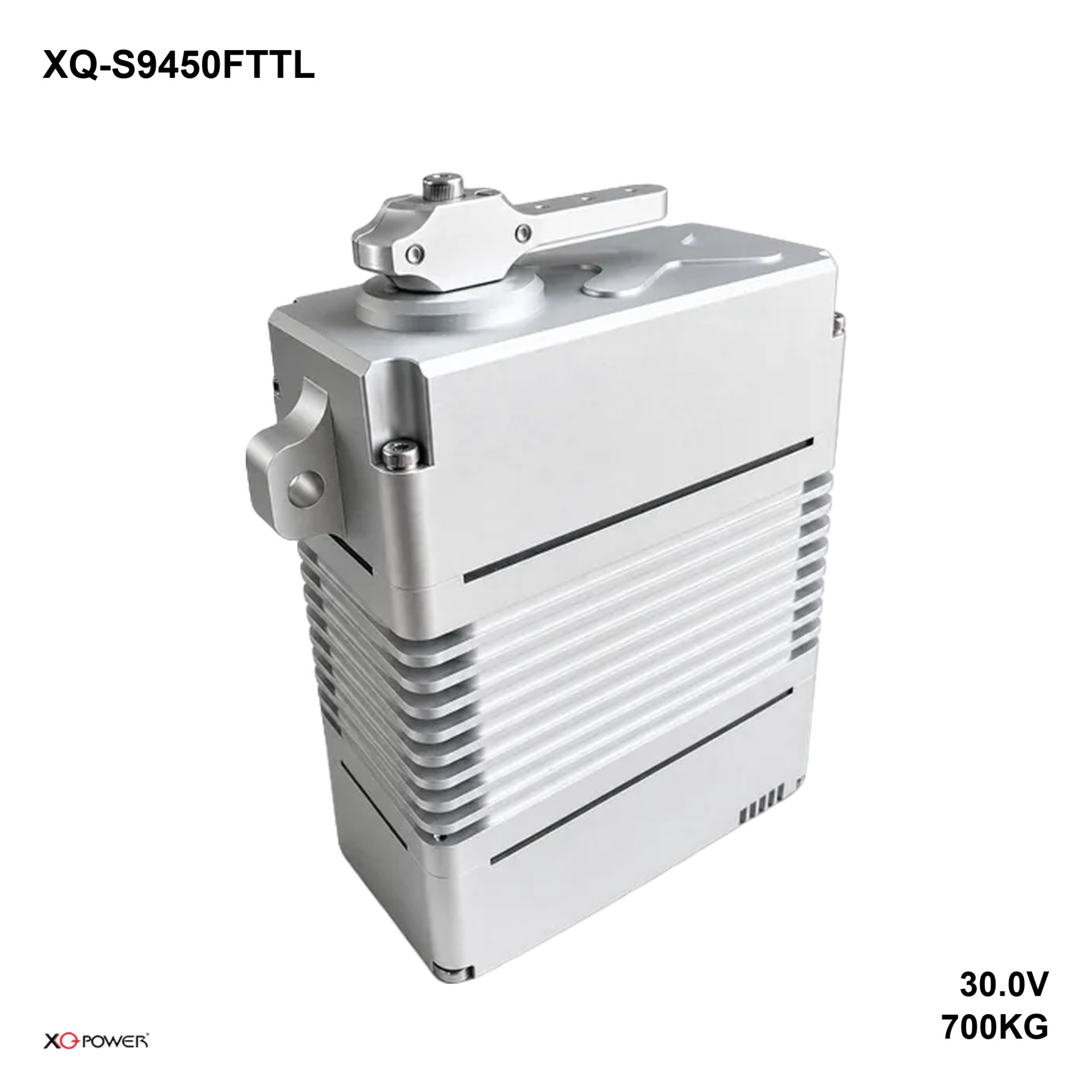
XQ-S9450FTTL — 700 kg·cm (68.6 N·m) with a TTL input, for a controller that sits beside the joint A brushless motor drives a steel train onto a 25T, φ11.98 mm output in eight ball bearings, inside a 100 × 50 × 97 mm machined aluminium case at 895 g, ears on the long sides so it bolts flat to a plate. The input stage is TTL serial: a board in the same enclosure drives the joint over a short lead, with no transceiver in between.
Rated 560 kg·cm on 24 V, 650 kg·cm on 28 V and 700 kg·cm on 30 V, with speed and current at each rail. Every figure comes from inspection sheet X9_9450.05, dated 2025-02-22.
| Peak stall torque700 kg·cmat 30 V · 9721.2 oz-in · 68.6 N·m | Speed0.21 s/60°at 30 V · 0.30 s at 24 V | Supply24–30 Vthree published points |
| ControlTTLTTL serial · 360° across 1000–2000 µs | Envelope100 × 50 × 97 mm122.7 mm across the ears · 25T-φ11.98 | Mass895 g8 ball bearings · no mechanical stop |
Is the XQ-S9450FTTL the right servo for your joint?
A TTL build suits a machine that carries its own controller. No bus to plan and no adapter: the board drives the joint directly, and the electronics sit in the same enclosure as the mechanism. On a 700 kg·cm axis that usually means a purpose-built machine with one heavy joint and a control cabinet mounted on it.
Travel is 360° across the 1000–2000 µs span and section 3-4 reads No Limit. The joint follows the board and the machine owns the end positions.
Specify this unit when
- The controller is a board inside the machine, close to the joint
- The lead from board to servo stays inside the enclosure
- The joint bolts to a plate with the output facing out
- The supply can hold 24–30 V at 22.5 A
- The move needs the better part of a full turn
Specify a different unit when
- The controller sits in a cabinet several metres away
- Several heavy joints have to share one port
- The axis depends on the servo for its end positions
- The supply sags below 24 V under load
- The joint needs more than 700 kg·cm
Torque and speed at 24, 28 and 30 Volts
Rows 4-1 to 4-13, three rails, locked-shaft figures. The serial input changes the wire count and leaves the torque and current columns where they are.
| Supply | Peak stall torque | No-load speed | No-load current | Stall current |
|---|---|---|---|---|
| 24 V | 560.0 kg·cm | 0.30 s/60° | 400 mA | 18 A |
| 28 V | 650.0 kg·cm | 0.25 s/60° | 430 mA | 21 A |
| 30 V | 700.0 kg·cm | 0.21 s/60° | 450 mA | 22.5 A |
700 kg·cm at 30 V with 0.21 s per 60°, 650 kg·cm at 28 V, 560 kg·cm at 24 V. The rail decides both figures by a wider margin than the interface does, so the supply is part of the joint specification.
No-load current 400 to 450 mA, stall 18 A at 24 V, 21 A at 28 V and 22.5 A at 30 V. The signal lead is short on this build and the power lead is not, so the gauge of the supply pair is what the installer has to get right.
Fit: envelope, spline and mass
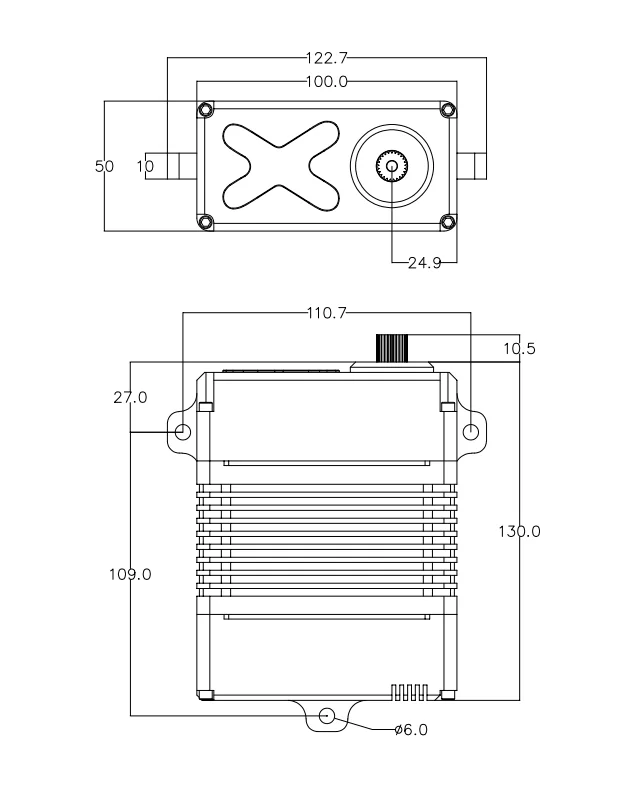
100 × 50 × 97 mm, 122.7 mm across the ears, 130.0 mm overall height and Ø6.0 holes on 15 mm ears. Ears on the long sides put the moment into the plate, and 700 kg·cm wants thickness and a rib behind it.
25T at φ11.98 mm with a metal arm supplied. At this size the arm is cut to the spline, and the output carries the full torque without a keyway.
895 g. On a static structure it is a mounting load; on a moving axis it is mass the drive has to accelerate and stop on every cycle.
Drive, current and heat
22.5 A at stall on 30 V and 450 mA at no load. The gear train does the work and the motor stays small, so the current is a wiring problem: a long thin supply pair drops volts at 22.5 A and hands the joint the 28 V column.
Dead band 3 µs, neutral 1500 µs, window 500–2500 µs, all customizable. The board works in these units directly, so the resolution it can command is the dead band and the point it treats as zero is the neutral figure.
Fins on the long faces and the drive mounted against them. At 22.5 A the case is doing real work, which is why section 2-2 stops at 60 ℃ and why a joint holding torque without moving reaches that limit first.
Eight bearings on the output, the most below the 1000 kg·cm frame. That is what keeps the shaft from deflecting at 700 kg·cm and what lets the arm run with no support at the far end.
Sealing and environment
Section 3-11 records splash resistance as Yes on a machined aluminium case with sealed joint faces. A higher water-protection grade is built to order, with the class and test standard agreed at order stage.
The J30J-15TJL connector sits outside the sealed volume, next to a signal lead and a heavy supply pair. Keep the plug dry or seal it to the same standard, and dress the harness down and away from the entry.
−30 ℃ to 60 ℃ operating, −30 ℃ to 70 ℃ storage. The upper figure arrives quickly on a joint holding a load without moving, because a sealed case gets rid of heat through its fins and nothing else.
Full specification
The complete sheet for the XQ-S9450FTTL, in the order it appears on inspection document X9_9450.05, dated 2025-02-22: measured figures throughout, and where we have none the row says so.
| Model | XQ-S9450FTTL |
| Peak stall torque (SI) | 68.6 N·m at 30 V |
| Voltage range | 24–30 V |
| Control interface | TTL serial |
| Amplifier | Digital controller |
| Rotating direction | CCW (1000–2000 µs), customizable |
| Angle of limit | None, no mechanical stop |
| Motor | Brushless |
| Gear train | Steel |
| Bearing system | 8 ball bearings |
| Output spline | 25T, φ11.98 mm |
| Horn supplied | Metal arm supplied |
| Case | Aluminium CNC, all-metal case |
| Dimensions | 100 × 50 × 97 mm |
| Weight | 895 g |
| Cable length | J30J-15TJL connector, purchased separately |
| Operating temperature | −30 ℃ to 60 ℃ |
| Storage temperature | −30 ℃ to 70 ℃ |
| Sealing | Splash-proof · higher water-protection grade built to order |
| Specification revision | X9_9450.05, dated 2025-02-22 |
Download the XQ-S9450FTTL datasheet (PDF)
The inspection sheet for this model, including the dimensional drawing and the control-signal table, is available as a PDF.
|
XQ-S9450FTTL inspection specification Revision X9_9450.05 · dated 2025-02-22 · PDF |
Download PDF |
If you need the drawing in DWG, a STEP model, or the control-signal table as a separate sheet, tell us which format your CAD system uses and we will send that instead.
Variants, samples and OEM work
The pulse build is S9450F, the CAN build S9450FC and the Modbus build RS9450FMB. The 250 kg·cm frame with the same input is S9200TTL.
Four input stages share this case: pulse, CAN, RS485 Modbus and TTL. All four use the same ear spacing, the same output and the same travel, so the choice comes down to what the controller speaks and how far it sits from the joint.
For OEM and ODM work on the XQ-S9450FTTL we start from five numbers: the torque you need at your speed, the supply you actually run, the interface your controller speaks, the envelope the joint allows, and the duty cycle. Send those and we answer one of three ways — the XQ-S9450FTTL covers it as stock at 700 kg·cm, a build of the same 100 × 50 × 97 mm frame does, or the axis needs a different frame. Send the XQ-S9450FTTL numbers to the engineering team.
Quick facts and cross-reference
The rows below are what to quote for the XQ-S9450FTTL: 700 kg·cm (68.6 N·m) on 24–30 V with TTL input, plus the two makes buyers usually weigh it against.
| Model | XQ-S9450FTTL |
| Peak stall torque | 700 kg·cm · 68.6 N·m at 30 V |
| Voltage range | 24–30 V |
| Control interface | TTL serial |
| Speed | 0.21 s/60° |
| Mass / envelope | 895 g · 100 × 50 × 97 mm |
| Also described as | serial bus servo, daisy-chain servo, smart servo, bus actuator |
Buyers often arrive here from a CubeMars AK series or a MyActuator RMD-X series, which are built around 24-48 V robot-platform rails as integrated actuators; the XQ-S9450FTTL is 700 kg·cm (68.6 N·m) on 24–30 V, so put the two on the same rail and in the same unit before comparing torque.
| Cross-reference | CubeMars AK series, MyActuator RMD-X series |
| Their typical rail | built around 24-48 V robot-platform rails as integrated actuators |
| This model | 700 kg·cm (68.6 N·m) on 24–30 V, TTL input |
FAQ
What does the TTL input expect?
The sheet specifies the command signal as TTL. The logic level your board drives and the frame it sends are agreed at order stage and set out in the protocol note that ships with the unit. Tell us the board and its output stage and we confirm the match in writing before the order.
How long can the signal lead be?
Keep it inside the enclosure and short. A single-ended line picks up what the supply pair radiates, and at 22.5 A that pair is loud. Where the controller has to sit metres away, use the RS485 Modbus or CAN build of this case.
What current has to reach the joint?
22.5 A at 30 V stall, 21 A at 28 V, 18 A at 24 V, plus 450 mA at no load. Size the supply pair on the stall figure and check the drop at the joint, because the last two volts are worth 50 kg·cm on this frame.
Does it have a mechanical stop?
No. Section 3-4 reads No Limit and 5-5 gives 360° across the 1000–2000 µs span. The machine owns its end positions, and at 700 kg·cm that is a structural requirement.
Is a lead included?
No. The case carries a J30J-15TJL connector and the mating lead is a separate purchase. Send the run length, the pinout and the gauge and the harness is quoted with the servo.
Why does the header say 450 kg·cm?
It is an earlier rating of this frame that was not updated when the winding changed. Rows 4-4, 4-8 and 4-12 give 560, 650 and 700 kg·cm, and this page quotes those measured figures.
Is the XQ-S9450FTTL a drop-in replacement for a CubeMars AK series?
No. The CubeMars AK series runs on a different rail and a different frame, while the XQ-S9450FTTL is 700 kg·cm (68.6 N·m) on 24–30 V with TTL input, so a swap means checking voltage, envelope and travel first. Send the rail and envelope your machine runs and we will say whether the XQ-S9450FTTL frame fits.
What should I compare before choosing between the XQ-S9450FTTL and a MyActuator RMD-X series?
Four numbers decide between the XQ-S9450FTTL and a MyActuator RMD-X series: peak stall torque in N·m, the rail you actually run, stall current, and whether your controller speaks TTL. The XQ-S9450FTTL publishes 700 kg·cm (68.6 N·m) on 24–30 V; put the MyActuator RMD-X series on that same rail and in the same unit before you compare the two.