
Servo spline standards catch more industrial integrators off guard than any other mechanical spec. A factory in Shenzhen called us last month because their AGV steering linkage developed play after 200 hours. They had swapped in a cheaper servo, reused the original aluminum horns, and assumed the spline pattern matched. It did not. The 24T horn on a 25T output shaft gripped just enough to work at first. Then it slowly chewed itself loose under load.
This is the kind of problem nobody thinks about until a machine is down and the replacement horn does not fit. Here is what actually matters when you spec a servo spline standard for industrial use.
What Servo Spline Standards Actually Define
The spline sits on the servo output shaft where the horn or arm attaches. It transfers every bit of torque from the gear train into whatever you drive — a linkage rod, a steering knuckle, or a camera gimbal. If the horn does not match the servo spline standard, the torque transfer fails completely. Not partially. Zero.
Two numbers define any servo spline standard: tooth count and outer shaft diameter. Most mid-to-large industrial servos use a 25T spline on a 5mm or 6mm shaft. This traces back to the Futaba pattern, and Savox, MKS, Xpert, and most industrial manufacturers now follow it. Hitec uses 24T instead. The difference is one tooth, and yet a 24T horn will never seat correctly on a 25T shaft. Micro servos often ship with 15T or 20T splines on a smaller 3-4mm shaft diameter.
25T vs 15T Servo Spline Standards: The Real Difference
A 25T spline on a 5-6mm shaft appears on any servo rated above roughly 30 kg·cm. Think AGV steering servos, robotic joint actuators, and heavy UAV control surfaces. The 25 teeth spread the load across more contact points, and that matters a lot when you push 100-180 kg·cm through a single aluminum horn.
Meanwhile, a 15T spline typically lives on sub-20 kg·cm micro servos with a 3-4mm output shaft. These work fine for throttle linkages, small camera gimbals, or lab automation grippers. However, they cannot handle sustained industrial torque. If your horn spec says 15T and your load demands 80 kg·cm, you chose the wrong servo entirely.
Why Servo Spline Compatibility Matters in the Field
The worst case happens after deployment. A horn strips or cracks at a customer site. Then the local technician grabs whatever sits on the shelf. A 24T horn forced onto a 25T shaft feels tight for a few cycles, but it starts slipping under load almost immediately. By the time the position feedback catches the error, the spline teeth on the output shaft have already deformed.
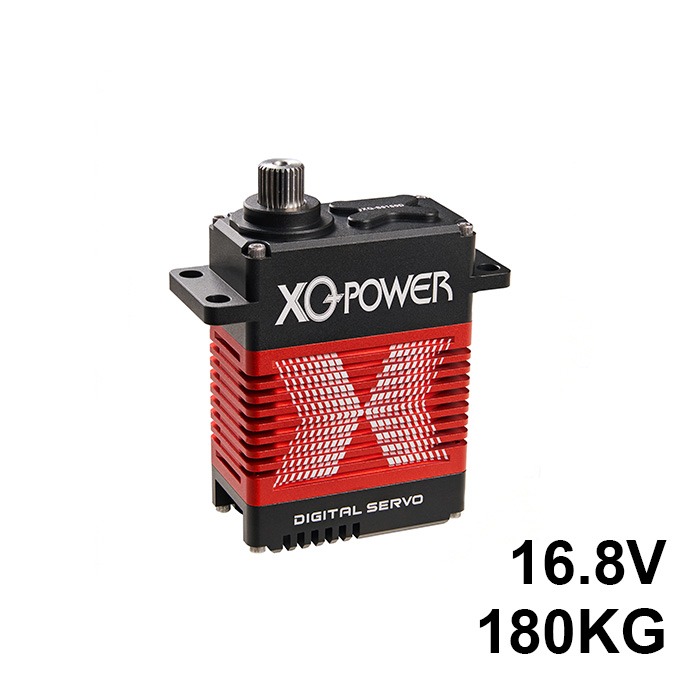
Because of this, we machine the output shafts on our S9150D and S8335DW series from hardened steel with a 25T spline standard. It is the most widely supported pattern in the industrial supply chain. Any technician with a Futaba-pattern horn kit can get the machine back online without guessing.
How to Identify Your Servo Spline Standard
Count the teeth directly. Mark one tooth with a marker and count around the full circle. Do not eyeball it, because 24T and 25T look nearly identical at a glance. Then measure the outer shaft diameter with calipers. Even with the same tooth count, a 25T/5mm shaft and a 25T/6mm shaft take different horns.
Most industrial servo manufacturers list the spline standard in the mechanical drawing on page two of the datasheet. If the drawing only shows an ISO view with no spline detail, ask for the CAD file. If they cannot provide one, find a supplier who can.