
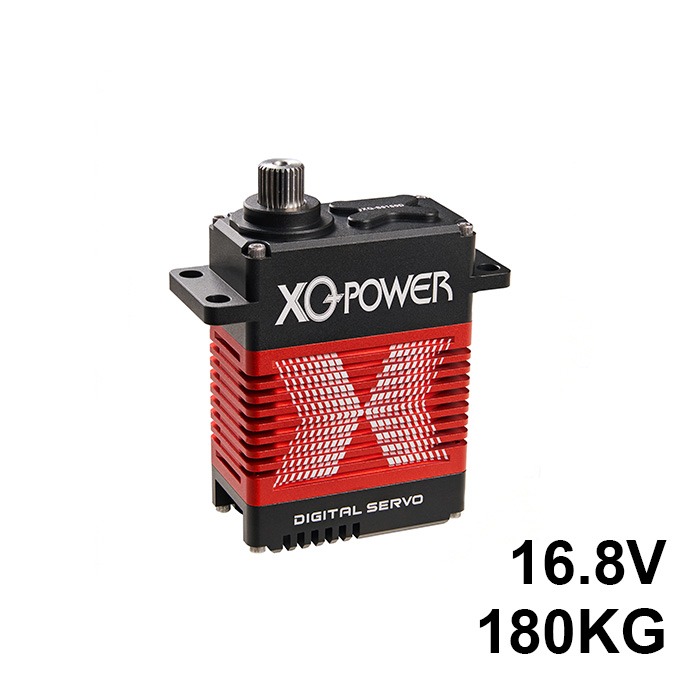
An automation integrator we worked with last quarter ordered 200 servos for a warehouse AGV fleet. The datasheet said 180 kg·cm at 16.8V. Installed them, ran a 48-hour burn-in, and half the fleet started drifting off center by day three. The problem was not the servo — it was what the datasheet did not say.
Every industrial servo datasheet follows roughly the same format, but knowing which numbers are real and which are marketing is the difference between a machine that ships on time and one that comes back under warranty. Here is how to actually read one.
Torque Ratings: Stall Torque vs Working Torque
The headline number on any servo datasheet — 100 kg·cm, 180 kg·cm, 1000 kg·cm — is almost always stall torque. That is the torque at which the motor stops turning, measured at the output shaft with a fixed arm. It tells you the absolute maximum before the motor burns out or strips the gear train.
Working torque is typically 60-70% of stall torque. If your application needs 150 kg·cm continuously, do not buy a servo rated at 150 kg·cm stall — you need at least 220 kg·cm. And at higher voltages, stall current climbs fast. A servo pulling 8A at stall on 16.8V will cook its windings in under 30 seconds without adequate cooling.
Also check the test voltage. Some manufacturers rate stall torque at 8.4V but show speed specs at 7.4V, hiding the fact that torque and speed trade off against each other. On our S9150D datasheet, every spec is measured at the same 16.8V so the numbers are directly comparable.
Speed Specs: No-Load vs Real-World
That 0.08 sec/60° number everyone quotes? That is no-load speed — the servo swinging an unloaded arm through 60 degrees in free air. Mount it in a linkage, add the mass of a steering knuckle or a camera gimbal, and that number doubles or triples.
The more useful spec, if the manufacturer provides it, is speed at 50% rated torque. This tells you how fast the servo actually moves when it is doing work. If the datasheet only shows no-load speed, assume real-world speed is 1.5-2x slower under load.
Deadband and Resolution: The Specs That Affect Precision
Deadband is the smallest input pulse width change the servo can detect — typically 1-4 µs. A 1 µs deadband at a 500-2500 µs PWM range gives roughly 2000 discrete positions. A 4 µs deadband gives 500.
For an AGV steering servo, 4 µs is probably fine. For a UAV control surface at 200 km/h, 1 µs might not be enough. The datasheet should state deadband explicitly; if it does not, that is a red flag.
The Stuff Datasheets Leave Out
Gear backlash, temperature rise at rated load, bearing type, pot or magnetic encoder lifespan — these almost never appear on a one-page spec sheet but matter more than the headline numbers for industrial buyers. Ask for the full test report. If the manufacturer cannot provide it, you are gambling.
A well-written industrial servo datasheet is honest about its limits. The best ones tell you what the servo cannot do, not just what it can.1