
“We used to stock six different servo variants for our robotic gripper assemblies — different speeds, different deadbands, different rotation limits. Switched to one programmable digital servo model and configured everything in software. Our BOM went from six SKUs to one, and field tuning takes two minutes instead of a hardware swap.”
— Diego Rojas, Automation Lead, Tecnova Industrial Robotics
Why Fixed-Parameter Servos Are a Logistics Problem
Most industrial integrators don’t buy one servo model. They buy half a dozen — same case, same torque class, but different firmware: one with 90-degree travel, one with 180, one with a tight deadband for precision work, one with a wide deadband to ignore signal noise. Each variant is a separate SKU in inventory. Each needs its own reorder point, its own shelf space, its own procurement cycle.
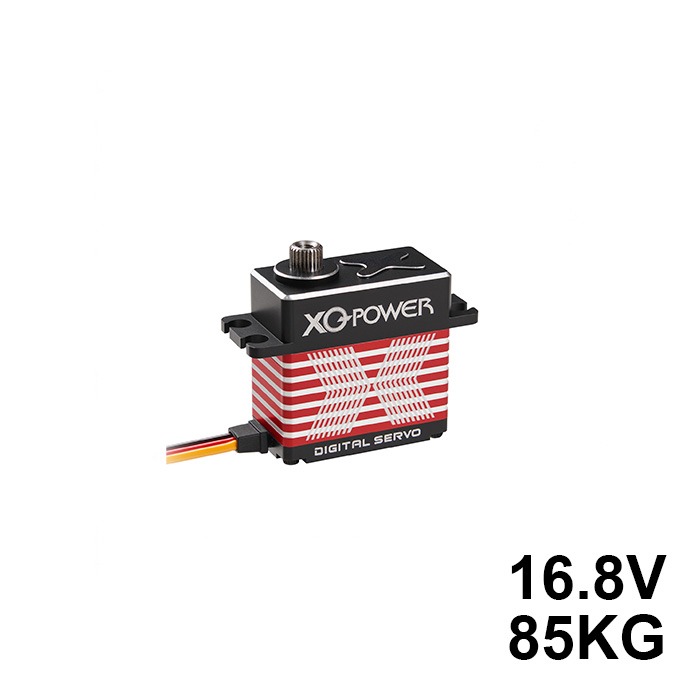
A programmable digital servo collapses that. Buy one model, configure it per application through a USB interface. The hardware is identical — the behavior is software-defined.
What You Can Change in Software
PID gains come first. The factory defaults work for general use, but bolt that same servo onto a robot arm swinging 5 kg at 60 cm, and the default P-gain causes overshoot. With a programmable unit, you drop P-gain, raise D-gain, and the arm settles smoothly. No trial-and-error buying different servo models.
Custom angle limits are just as useful. Most standard servos lock you to 90 or 180 degrees. If your linkage geometry needs exactly 127 degrees, a programmable servo lets you set it — no mechanical stops, no compromises.
Signal loss behavior is the third big one. A standard servo either holds position or goes limp when PWM drops. A programmable unit lets you define a safe preset angle, a timed hold-then-release sequence, or a specific torque duration before freewheeling. In a UAV flight surface or a valve actuator, that’s not a feature — it’s a safety requirement.
Where It Pays Off
If your application never changes and you buy the same servo forever, skip it. The programmer and the premium aren’t worth it.
Programmable digital servos make sense when you ship ten slightly different machine configurations and don’t want to stock ten servo variants. When you need synchronized motion profiles across a multi-axis system. When load characteristics change between deployments and on-site tuning is faster than re-specing hardware.
XQ-Power’s digital line supports programmable firmware from 17 kg-cm up to the 1000 kg-cm S9750, all through a single USB interface. Configure one unit, save the file, clone to the rest.