
“We ran steel gear servos on our UAV pitch actuators for two years. The fatigue failures were unpredictable — sometimes 800 hours, sometimes 1,200. Switched to titanium gear servos 14 months ago. Haven’t lost a single unit since.” — Marcus Keller, Alpine UAV Systems A titanium gear servo isn’t for everyone. If your actuator sits on a factory floor test rig where weight doesn’t matter and a failed unit gets swapped in ten minutes, buy steel and call it a day. But if your servo flies, dives, or runs 24/7 where a mechanical failure has real consequences, titanium gearing changes the math.
The difference comes down to two things: fatigue life and weight.
Steel gears develop micro-cracks after roughly a million load cycles. A flight control servo correcting pitch 200 times per minute blows past that threshold inside a hundred flight hours. Titanium alloy gears — typically Ti-6Al-4V in servo applications — last roughly twice as long under the same cyclic stress. Not because they’re harder. Because the material handles repeated elastic deformation without the crack propagation you get in hardened steel.
Weight is the other factor. Titanium is 40% lighter than steel at equivalent strength. On a UAV with eight control surface actuators, saving 6-8 grams per servo means real flight endurance gains. In an underwater ROV where every gram of buoyancy matters, it means smaller floatation modules and a more compact vehicle.
Corrosion matters too, especially in marine applications. Steel gears in an aluminum servo housing create a galvanic couple when salt spray or condensation gets in. The steel pits first, and once the tooth contact surface roughens, wear accelerates fast. Titanium sits close enough to aluminum on the galvanic scale that this basically doesn’t happen.
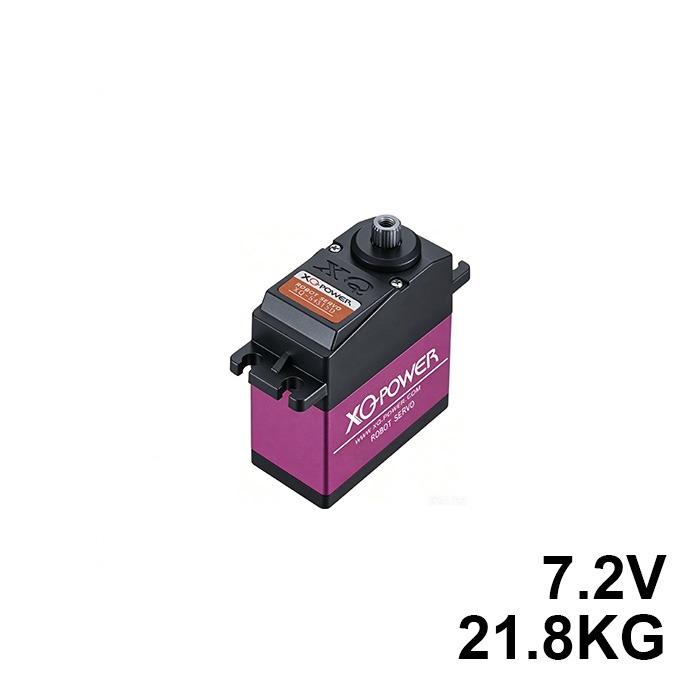
XQ-Power’s titanium gear servos — models like the S4016D and S4020D — use solid Ti-6Al-4V output gears, not a titanium coating over steel. The intermediate stages stay hardened steel because that’s where the cost-to-performance ratio makes sense. It’s a practical hybrid, not a spec-sheet flex.
When Titanium Gears Are Worth the Premium
You’re paying roughly 50% more for a titanium gear servo versus all-steel at the same torque class. That premium only makes sense when:
- The servo flies. UAV and drone applications where every gram counts.
- It operates in saltwater or high humidity. Marine robotics, offshore equipment.
- The duty cycle is relentless. 24/7 automation where replacing a servo means stopping a production line.
For ground-based AGVs or warehouse robots where the servo weighs 300 grams and the vehicle weighs 2,000 kg, skip titanium. The weight saving is irrelevant and steel holds up fine at those torque levels.
The math isn’t “titanium is better.” It’s “what does a failure cost.”