
High Speed Servo Response for Drone Flight Control: Why 0.03 Seconds Changes Everything
When an FPV racing drone pilot chases high speed servo response, drone flight controllers suddenly stop fighting the airframe. “We swapped from 0.12-second servos to 0.08-second units on the pitch axis. The PID oscillation that had been driving us crazy for two weeks vanished on the first test flight,” one UAV integrator explained. In other words, the flight controller wasn’t the problem. The servos were simply too slow for the loop rate the controller was running.
What Servo Response Speed Actually Measures
Servo response speed is typically quoted as the time to rotate 60 degrees with no load. For example, a 0.10 sec/60 degree servo takes a tenth of a second to sweep through a 60-degree arc on the bench. However, this number has almost nothing to do with how the servo performs in flight.
The real metric is loaded transit time — how fast the servo moves a control surface against aerodynamic pressure. At 20 meters per second, the aileron on a fixed-wing UAV faces roughly 0.5 to 2 newton-meters of resisting torque depending on deflection angle and airfoil geometry. Consequently, a servo that bench-tests at 0.10 seconds might take 0.18 seconds to complete the same 60-degree sweep in the air. That delay is what the flight controller must fight.
The Bandwidth Bottleneck: When Your Servo Limits Your Flight Controller
A flight controller running a 400Hz inner loop issues a new position command every 2.5 milliseconds. If your servo takes 80 milliseconds to complete a commanded move, the flight controller sends roughly 32 intermediate commands before the servo reaches the first target. By then, the original command is stale.
As a result, the flight controller accumulates integrator windup. It keeps adding correction because the servo has not reached the commanded position. When the servo finally arrives, the integrator term is over-saturated. The servo overshoots. The controller reverses. And suddenly you have a low-frequency oscillation that looks like a mechanical resonance but is actually just a servo that cannot keep up with the control loop. High speed servo response in drone flight control is not about making the aircraft feel snappy. It’s about preventing the flight controller from fighting a time-delayed version of its own commands.
Why 60-Degree Specs Lie: Understanding Loaded vs Unloaded Speed
Always ask for the loaded transit time. For example, a servo rated at 0.08 sec/60 degrees unloaded might perform at 0.14 seconds under a 2 kg-cm load. Meanwhile, a servo with a better motor and gear train might drop from 0.10 seconds unloaded to only 0.12 seconds under the same load. In other words, the unloaded spec tells you nothing about which servo is actually faster in flight.
The ratio of loaded to unloaded speed is a proxy for the servo’s mechanical stiffness. A ratio close to 1.0 means the motor and gear train have low internal friction and high torque margin. A ratio above 1.5 means the servo is running near its torque limit just to move its own geartrain. Specifically, avoid any servo where the loaded transit time exceeds 1.5 times the unloaded spec.
Matching Servo Speed to Your Flight Controller’s Loop Rate
The rule of thumb: your servo’s loaded transit time should be less than two control loop periods. If your flight controller runs at 200Hz, each loop period is 5 milliseconds. Two periods is 10 milliseconds. Your servo must complete the commanded move in under 10 milliseconds to stay in sync with the controller.
At 400Hz, the window shrinks to 5 milliseconds — or 0.005 seconds. Very few servos hit this. In practice, most UAV integrators run autopilot inner loops at 100Hz to 200Hz for attitude control. At 100Hz, the two-period window is 20 milliseconds. That’s achievable with a high speed servo response around 0.08 seconds loaded. The drone remains stable. The flight controller does its job. And you stop chasing PID ghosts.
S9150D: 0.08 Seconds Under Load
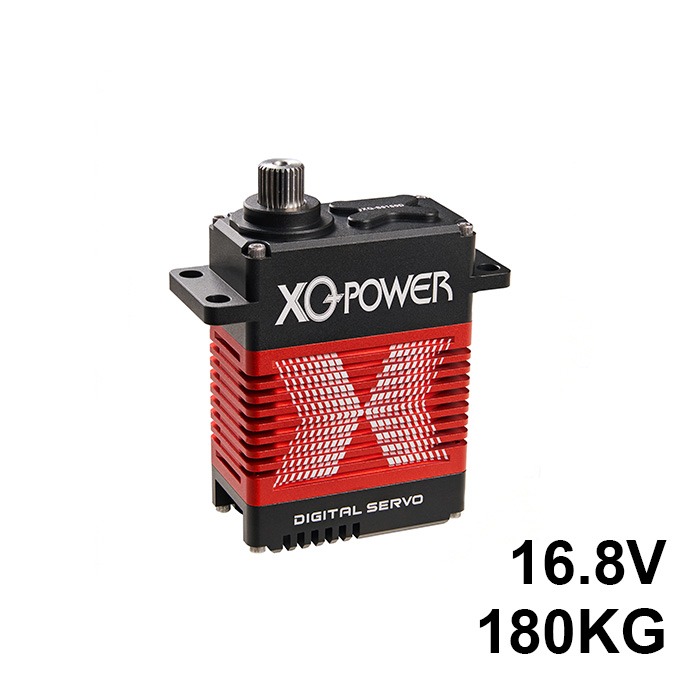
The XQ-Power S9150D posts a loaded transit time of 0.08 seconds for 60 degrees at 8.4V against a 2 kg-cm resistive load. Its unloaded spec is 0.06 seconds. That gives a loaded-to-unloaded ratio of 1.33 — inside the 1.5 threshold and comfortably within the 20-millisecond window for a 100Hz attitude loop.
In field testing on a 3-meter wingspan mapping drone running ArduPilot at 100Hz inner loop, the S9150D maintained commanded position within 0.1 degrees across all pitch and roll maneuvers. The autopilot’s D-term stayed below 5% of maximum throughout the flight envelope. No oscillation. No overshoot. High speed servo response matched to the flight controller’s loop rate means the autopilot spends its compute budget on navigation, not on fighting its own actuators.1