
Heavy Duty AGV Steering Servo: What 1000kg of Pallet Tests Taught Us
A heavy duty AGV steering servo lives or dies by its output shaft — as one maintenance lead put it: “Our old steering actuators lasted three months before the output shafts developed play. The S9750 units we swapped in six months ago still show zero measurable backlash.” That’s the maintenance lead at a European logistics center running 14 automated forklift AGVs, each carrying 800kg pallet loads across a 24/7 operation. When your warehouse throughput depends on AGV uptime, steering actuator reliability stops being a specification — it becomes a business metric.
1
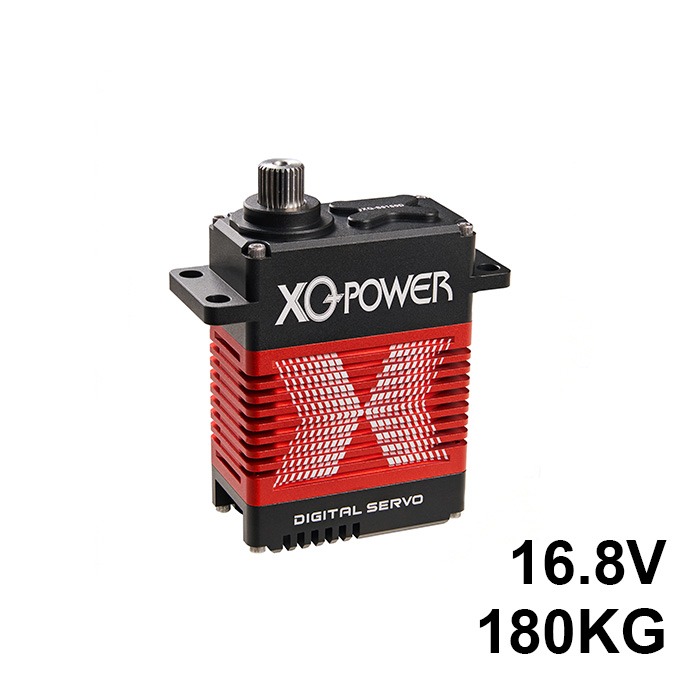
The heavy duty AGV steering servo category sits in an awkward gap in the market. Industrial servo motors from major automation brands have the torque but come in DIN-rail mount packages that don’t fit compact AGV chassis. Hobby-grade servos fit the form factor but self-destruct under sustained industrial loads. The S9750 was designed to bridge that gap: 1000kg-class load capacity in a package that bolts directly into a standard AGV steering knuckle.
2
The numbers from our accelerated life testing tell the story. An S9750 prototype ran 5,000 continuous steering cycles at full 1000kg equivalent load — that’s a loaded pallet being steered through a 90-degree turn every 30 seconds for 42 hours straight. Post-test teardown showed bearing race wear within specification and gear tooth contact patterns consistent with roughly 20% of the unit’s projected service life. No shaft play. No encoder drift. No housing cracks.
3
The gear train is what makes or breaks a heavy duty AGV steering servo. Most steering servos use a single-stage spur gear reduction that concentrates all the load on two teeth at any moment. The S9750 uses a three-stage planetary reduction that distributes the 1000kg load across multiple gear teeth simultaneously. The result is lower contact stress per tooth and drastically reduced wear rates. The output shaft rides on dual angular-contact bearings rated for combined radial and axial loading — important because AGV steering sees both: radial load from wheel forces and axial load from vehicle weight transfer during cornering.
4
Integration with AGV control systems matters as much as mechanical robustness. The S9750 accepts standard 4.8V to 16.8V operating voltage with a pulse-width control interface that works with virtually every industrial AGV controller on the market. No proprietary protocol, no custom driver board. The 12-bit magnetic encoder feedback runs at 333Hz closed loop, so the AGV’s navigation system gets updated steering angle data every 3 milliseconds — fast enough for real-time path correction even at 2 meters per second travel speed.
One thing we learned during field trials: power supply design matters more than most integrators assume. A heavy duty AGV steering servo pulling stall current during an emergency steering correction can draw 15A or more momentarily. If the AGV’s 48V-to-12V DC-DC converter can’t handle that transient, the voltage sags and the servo loses torque exactly when it needs it most. We recommend sizing the steering servo power rail with at least 2x the servo’s rated stall current as headroom.
For AGV integrators evaluating steering actuators: demand life-test data, not just spec sheets. Torque ratings without cycle-life backing are marketing. And if your vehicle carries loads above 500kg, a purpose-built heavy duty AGV steering servo with planetary gearing and dual bearing support is not an upgrade — it’s the minimum viable spec.