
Servo Motor for Robotic Arm Joints: It’s Not Just About Lifting
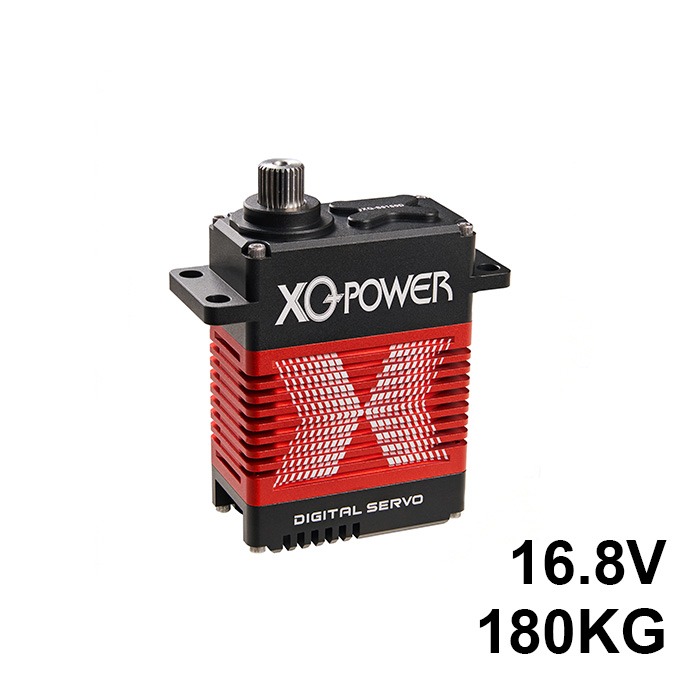
Selecting the right servo motor for robotic arm joints can transform cycle time and reliability — as one integrator told us: “When we switched from steppers to industrial servos on the shoulder joint, cycle time dropped 40% and we stopped losing position during emergency stops.” That’s from a packaging automation integrator who retrofitted a pick-and-place cell with six XQ-Power S9150D servos. The steppers worked fine on paper. In practice, the arm occasionally stalled during rapid deceleration, and every stall meant 20 minutes of re-homing the entire cell.
A servo motor for robotic arm applications faces three challenges that simpler motion control applications never encounter. First, the torque demand changes constantly with joint angle. Second, any backlash in the transmission becomes amplified by the arm’s reach. Third, the servo must respond to external forces — the arm might collide with an obstacle, grab a heavier-than-expected object, or experience tool reaction forces — without losing position or damaging itself.
Torque profiling for each joint is non-negotiable. The shoulder joint of a 6-axis arm sees maximum torque when the arm is extended horizontally — the worst-case lever arm. The same joint at vertical sees near-zero gravity torque. A servo motor for robotic arm shoulder applications must deliver peak torque at the horizontal position while operating efficiently at partial load during the rest of the motion cycle. This is where the S9150D’s 180kg-cm peak torque and efficient partial-load operation makes sense: the servo delivers when the joint needs it and doesn’t overheat when it doesn’t.
Backlash in the transmission — whether from gear teeth, coupling flex, or shaft keyway clearance — creates a dead zone between the motor’s command and the end effector’s actual position. Every degree of backlash at the shoulder joint translates to millimeters of uncertainty at the gripper, multiplied by the arm’s reach. For a 1.5-meter arm with 0.5 degrees of backlash at the shoulder, the gripper position uncertainty is roughly 13mm. That’s the difference between picking a part and crushing it. Industrial servo motors with precision-ground gear trains and zero-backlash couplings are the only way to bring that number down.
Emergency stop behavior separates industrial-grade servo motors from hobby-grade units. When an E-stop triggers, the arm doesn’t just coast to a halt — it must decelerate in a controlled manner without dropping the load. Dynamic braking in the servo drive shorts the motor windings, converting kinetic energy to heat and bringing the arm to a fast, controlled stop. After power is restored, a closed-loop servo motor for robotic arm joints returns to its last known position automatically. Open-loop steppers need a full homing sequence, which might not be possible if the workspace has changed.
The wrist joint — axes 4, 5, and 6 — presents a different challenge. These joints sit at the end of the kinematic chain, so weight matters enormously. Every gram saved at the wrist reduces the torque demand on the elbow and shoulder. This is where compact form factors like the XQ-Power low-profile series become relevant, trading some peak torque for reduced mass and smaller envelope.
For integrators building or retrofitting robotic cells: choosing a servo motor robotic arm solution starts with the worst-case joint torque at full extension. Add 30% safety margin, then work backward through the transmission to size each servo. And don’t skip the E-stop testing. The servo that holds position during a controlled stop is worth ten that don’t.