
Lightweight Servo Design for UAV: How Every Gram on the Control Surface Eats Into Your Flight Time
If you have ever run the numbers on lightweight servo design, UAV endurance math makes one thing painfully clear: every gram on a control surface costs you disproportionately. “We shaved 22 grams per servo across six control surfaces. That’s 132 grams total,” one agricultural drone integrator told us. “Suddenly the battery math made sense for the 10-hectare spray routes.” In other words, the servos weren’t the heaviest component on the aircraft. But they were the easiest place to cut weight without touching the payload or battery.
Why One Gram on a Servo Costs More Than You Think
Weight on a control surface isn’t static mass. It’s rotational inertia. A heavier servo on the aileron requires the servo itself to work harder just to overcome its own mass during deflection. Meanwhile, the flight controller must command more current for every correction. As a result, the weight penalty compounds twice: once from carrying the mass and once from the extra power draw to move it.
For a typical fixed-wing survey UAV with four control surfaces, every gram saved on servo weight translates to roughly 0.8 seconds of additional flight time per gram. That sounds small. However, across a 90-minute mission profile with six servos, shaving 20 grams each nets approximately 2.5 extra minutes. In practice, that’s the difference between completing the survey grid and landing short.
The Weight Budget: Servo Mass vs Battery Mass
Battery weight is your primary lever for endurance. But battery capacity scales linearly with mass while flight time scales sub-linearly — more battery means more weight, which means more power needed just to stay airborne. Consequently, there’s a diminishing return point where adding battery grams stops buying you flight minutes. At that point, lightweight servo design becomes the smarter investment.
Here is the math. Removing 100 grams from the airframe total typically adds 1.5 to 3 minutes of flight time depending on the platform. Adding 100 grams of battery might add 4 to 5 minutes. However, if you are already at the battery’s diminishing return threshold, those 100 grams of battery might only buy you 2 minutes. Meanwhile, the servo weight reduction works at any point on the curve. It never hits diminishing returns.
Materials That Cut Weight Without Sacrificing Torque
Aluminum center cases and titanium gear trains are the two biggest levers in lightweight servo design. For example, switching from a brass output gear to a titanium gear saves roughly 30% on the gear train mass. Similarly, an aluminum mid-case instead of a full steel housing cuts another 15 to 20 grams. Crucially, neither change reduces torque capacity if the gear geometry is designed for the material.
Polymer composite cases are another option. However, they come with a thermal trade-off. Plastic housings insulate heat rather than dissipating it. For a UAV control surface servo that runs at low duty cycle, this is acceptable. For a continuously oscillating stabilizer servo, however, aluminum is the minimum viable material for thermal management.
S9150D: What 68 Grams Buys You
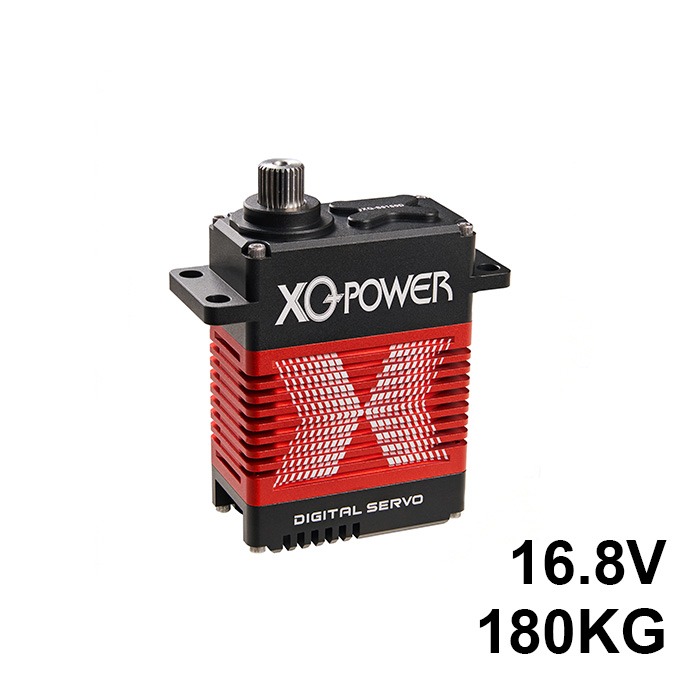
The XQ-Power S9150D weighs 68 grams complete with titanium gears and an aluminum mid-case. Its torque output is 25 kg-cm at 8.4V. By comparison, a typical brass-gear steel-case servo with the same torque rating weighs 85 to 95 grams. In other words, the S9150D delivers the same control authority at roughly 25% less mass.
On a fixed-wing UAV with four aileron and two elevator servos, this saves approximately 100 to 160 grams across the full servo set. For a 5 kg all-up-weight survey drone, that’s a 2 to 3 percent reduction in total vehicle mass. And every percent matters when you are flying hour-long grid patterns over uneven terrain.
How to Audit Your UAV’s Servo Weight Budget
Before your next build, weigh every servo on a precision scale. Record the mass and torque rating for each position. Then calculate the torque-to-weight ratio in kg-cm per gram. Anything below 0.3 kg-cm per gram is a candidate for replacement.
Next, compare the weight of your heaviest servo against the lightest option with the same torque spec. If the gap is more than 15 grams per unit, the upgrade pays for itself in endurance. Multiply by the number of servos on the aircraft. Finally, test the new servos in a hover or loiter configuration and measure the actual current draw difference. Lightweight servo design for UAV platforms is not a theoretical optimization. It’s a measurable flight-time gain that shows up on the battery telemetry log.1