
If you have ever debugged a UAV stability problem and traced it back to servo deadband and centering accuracy, you know the frustration. “We swapped to servos with 0.03 degree deadband and the yaw oscillation just disappeared,” one integrator told us. “No PID retuning, no firmware patch. Just different servos.” In other words, the flight controller was doing its job perfectly. Meanwhile, the servos were lying to it.
What Servo Deadband Actually Means
Servo deadband is essentially the smallest input change a servo can physically respond to. For example, if your deadband is 1 microsecond, a 0.5 microsecond pulse change does nothing. As a result, the servo sits there. The flight controller sees zero attitude change. Consequently, it calculates a bigger correction. It sends a bigger pulse. And then the servo jumps — and overshoots.
The flight controller sees the overcorrection and pulls back. Suddenly you have a 3Hz oscillation on your roll axis. However, this has nothing to do with PID gains. Instead, the servo deadband and centering accuracy gap created a control discontinuity. Specifically, the flight controller misreads it as inertia or damping. But it’s actually just mechanical hesitation.
Centering Accuracy: The Return-to-Neutral Test
Send a 1500 microsecond neutral pulse to your servo. The shaft stops at some angle. Then command it to 2000 microseconds, hold, and return to 1500. Ideally, the shaft should land at exactly the same angle.
On a cheap servo, however, it might be off by 0.5 degrees. That’s half a degree of permanent control surface deflection on a UAV at 20 meters per second. Over a 500-meter straight segment, a 0.5 degree aileron offset accumulates roughly 4.3 meters of lateral drift. Naturally, your flight controller fights it. But it’s fighting a constant bias. In other words, it’s burning control authority on error correction instead of maneuver performance.
The UAV Servo Specs That Matter
First, deadband under 1 microsecond means the servo resolves position changes finer than the PWM resolution of most hobby receivers. In practice, that’s effectively zero deadband from the system perspective.
Second, centering accuracy under 0.05 degrees means return-to-neutral error falls below the noise floor of most MEMS IMUs. Therefore, the flight controller literally cannot distinguish it from sensor noise. If your specs are worse than these thresholds, your autopilot is compensating for mechanical imprecision. And that’s a losing game.
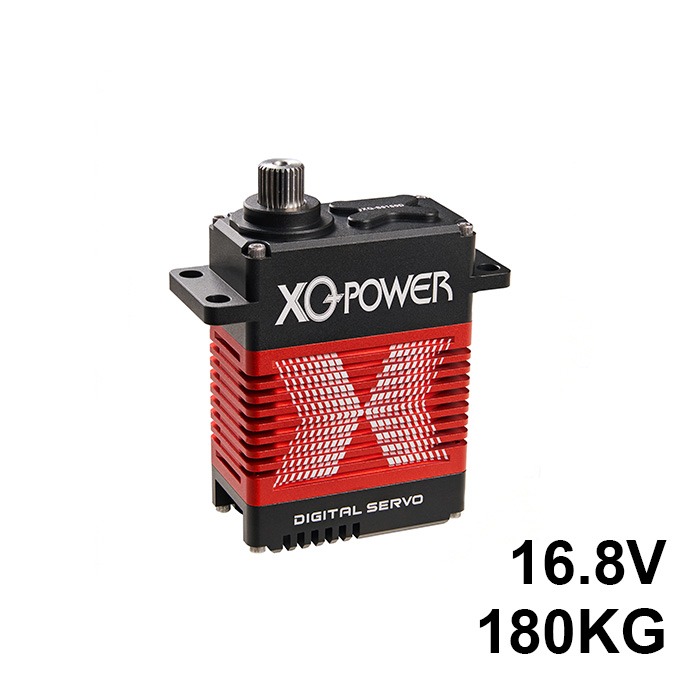
S9150D: Real-World Test on a Survey Drone
The XQ-Power S9150D uses a 12-bit magnetic encoder running closed-loop at 333Hz. Measured deadband: 0.8 microseconds. Tested centering accuracy: within 0.04 degrees across 10,000 cycles.
In field testing on a fixed-wing survey UAV with 2.6-meter wingspan, swapping to these servos eliminated a persistent 0.8-degree roll bias. Previously, the Pixhawk autopilot had been compensating with constant aileron trim. After the swap, the autopilot’s roll integrator term dropped from 12% to under 1% of control authority. Ultimately, the flight controller stopped fighting the servos and started flying the aircraft.
How to Verify Your Own Servos
Before you trust your airframe to any servo, test it. You need a servo tester with 1-microsecond step resolution and a digital protractor with 0.01-degree precision.
First, command 1500 microseconds. Mark the position. Next, sweep to 2000, then back to 1500. Measure the offset. Repeat this ten times. If the average return error exceeds 0.1 degrees, that servo has no business on a UAV control surface. Similarly, if it ignores step changes under 2 microseconds, same verdict. Remember, servo deadband and centering accuracy specs on a datasheet are a promise. So verify them before you put your aircraft at altitude.1