
Direct answer: Yes, prolonged direct sunlight and high heat can accelerate aging of servo cable jackets, plastic parts, seals, lubricants, and internal electronics. The actual risk depends on material selection, enclosure temperature, sealing design, cable routing, workload, duty cycle, and exposure time.
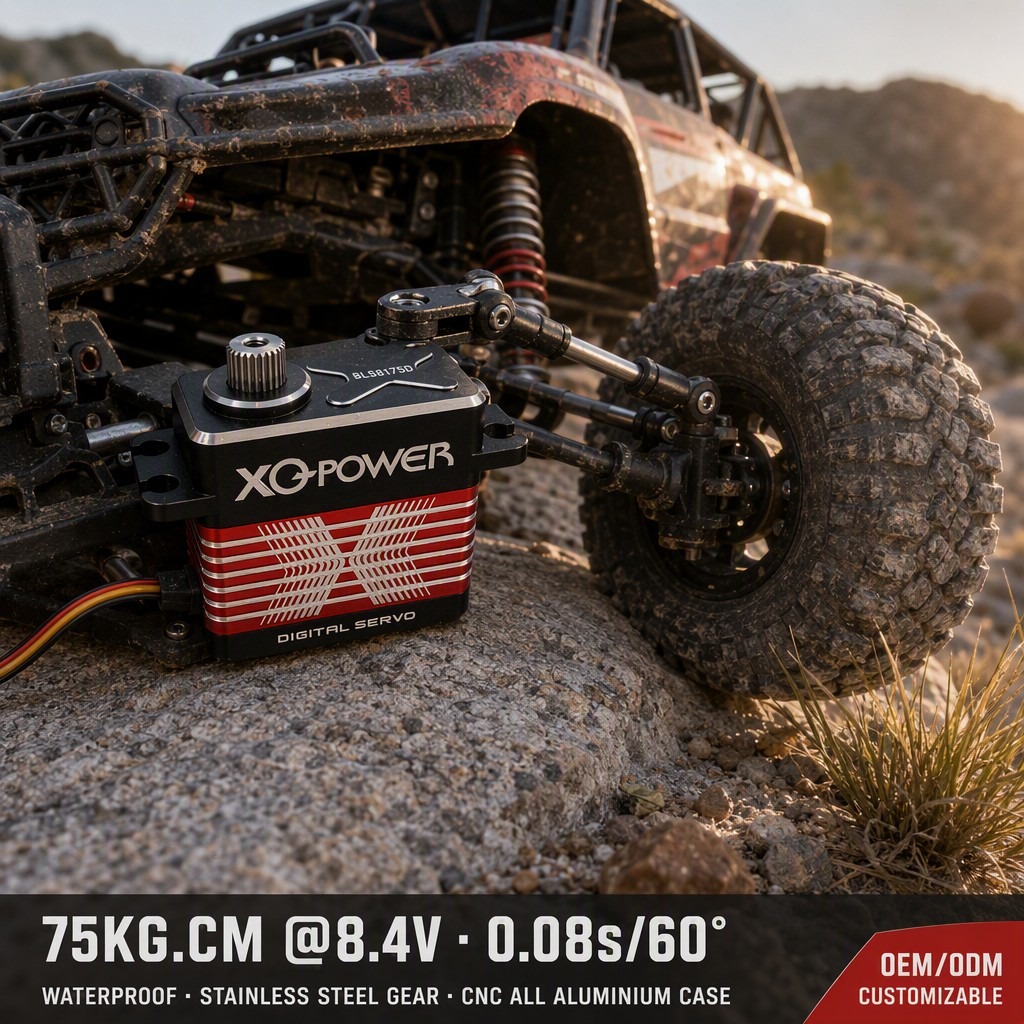
For outdoor equipment, an XQPOWER servo should not be evaluated only by torque and speed. Solar radiation adds ultraviolet exposure and raises the surface temperature of the housing. A metal housing can provide structural strength and help transfer heat, but it does not automatically mean that the cable jacket, seals, coatings, or connectors are UV-resistant.
Important note: Water resistance, splash resistance, and UV resistance are different specifications. A model with a water-resistance rating is not automatically qualified for long-term UV exposure. UV-resistant cable jackets, continuous temperature limits, and outdoor service life should be confirmed for the specific model and application.
Why Can Direct Sunlight Accelerate Servo Aging?
1. UV exposure can affect cable jackets and external plastic parts
Long-term UV exposure may cause some polymer materials to discolor, harden, lose flexibility, or crack. Inspect the cable jacket, the cable exit, waterproof plugs, seals, connectors, and other exposed plastic parts. Look for whitening, hardening, surface cracks, peeling, loss of elasticity, or damage around repeated-bend areas.
For servos installed on outdoor robotic arms, agricultural equipment, RC vehicles, or UAV-related equipment, route the cable through a shaded or protected area whenever possible. Avoid placing the cable exit where it is exposed to standing water, dirt accumulation, continuous tension, or a small bending radius.
2. Housing temperature adds internal thermal load
Direct sunlight can make the servo housing substantially hotter than the surrounding air. Internal temperature also rises because of motor copper loss, driver dissipation, high load, low-speed operation, or stall conditions.
Potentially affected parts include motor windings and the driver thermal margin, MOSFETs and other electronics, gearbox lubricant, sealing materials, the magnetic encoder, and the control board. A short power-on test is not enough to prove suitability for year-round direct sunlight. Use temperature-rise, load-cycle, operation, and cool-down testing based on the actual installation.
3. A metal housing helps with structure and heat transfer, but is not complete weather protection
The XQPOWER BLS8175D product page lists a CNC aluminum housing, a contactless magnetic encoder, stainless-steel gears, a 6.0–8.4V high-voltage range, and IP67 protection. These specifications can be useful reference points for a high-load outdoor application, but the actual installation must still be evaluated for direct sunlight, salt spray, mud, water exposure, and continuous temperature rise.
For product construction and application details, see the XQPOWER BLS8175D 75kg High-Torque Brushless Servo.
Which Servo Parts Should Be Checked First Outdoors?
| Servo part | Main outdoor stresses | What to check |
|---|---|---|
| Servo housing | Solar heat, surface temperature rise, coating or plastic aging | Measure housing temperature after continuous operation; inspect discoloration, deformation, and cracks |
| Cable jacket | UV exposure, thermal cycling, bending, and tensile stress | Check for hardening, whitening, cracks, abrasion, and stress at the cable exit |
| Seals | Heat, dust, mud, water, and thermal cycling | Check interfaces, end covers, and cable exits for looseness or water traces |
| Gears and lubricant | High temperature and high load may affect lubrication | Monitor noise, backlash, centering, and no-load current |
| Electronics | Reduced thermal margin; stall increases heat | Record current, alarms, thermal protection, and unexpected resets |
| Position feedback | Temperature changes may affect long-term stability | Compare centering and positioning accuracy when cold and when hot |
How Can You Reduce Sunlight-Related Servo Stress?
Use a sun shield without blocking heat dissipation
Use a sun shield, equipment enclosure, or structural cover to reduce direct radiation while keeping enough ventilation for heat to escape. Do not place the servo in an airtight box that traps heat.
Route the cable away from direct sunlight and standing water
Run the cable along the protected side of the equipment where possible. Use suitable clamps to reduce vibration and repeated bending. Avoid sharp bends and continuous tensile load near the cable exit.
Separate water-resistance, splash-resistance, and UV-resistance requirements
Different models may be intended for splash, rain, mud spray, or more demanding water exposure. An IP67 rating should be interpreted according to the specific product specification and installation conditions. Ingress protection does not replace UV-aging, salt-spray, or high-temperature life testing.
Control load and stall risk at high temperature
Avoid continuous near-stall operation in direct sunlight. High load, low speed, or mechanical blockage can increase current and temperature. Use mechanical limits, suitable travel and soft-start/soft-stop settings, current or temperature monitoring, operation/cool-down cycles, and post-operation checks for abnormal noise, backlash, or centering drift.
For bus or smart servos, log voltage, current, temperature, and position feedback when the controller supports it. This creates a baseline for outdoor-life evaluation.
What Should You Confirm with the Servo Supplier?
- Does the cable jacket have a UV-resistant or equivalent outdoor-weathering specification?
- Is the product splash-resistant, IP67, or another clearly defined protection level?
- Do the protection-test conditions match the actual mounting direction and cable-exit arrangement?
- What are the recommended operating and storage temperatures, and the temperature-rise limits under direct sunlight?
- What continuous torque, peak torque, and duty cycle are allowed at high temperature?
- Are there high-temperature cycling, salt-spray, vibration, or cable-flex-life test results?
- Are there installation recommendations for UAVs, robots, agricultural equipment, or marine equipment?
- What is the engineering-confirmation process for custom cable lengths, connectors, communication protocols, or protective structures?
If the application includes strong sunlight, rain, mud, salt spray, or continuous vibration, provide the supplier with the environmental conditions, load profile, operating duration, mounting location, and cable routing—not only torque and speed.
Frequently Asked Questions
Not necessarily. The risk depends on solar radiation, ambient temperature, housing temperature, workload, operating time, cable material, and protection. Short-term outdoor use and year-round exposure should be evaluated as different conditions.
No. The metal housing itself may be less vulnerable to UV powdering than some plastics, but coatings, end covers, seals, connectors, and cable jackets can still be affected. The housing can also absorb solar heat and raise the internal temperature.
No. IP67 describes dust and water-ingress protection under specified test conditions. It does not by itself prove UV resistance, salt-spray resistance, or long-term high-temperature exposure life. Check the specific product specification and application conditions.
Look for hardening, whitening, loss of flexibility, cracks, peeling, and abrasion—especially near the cable exit and repeated-bend areas. Intermittent power loss, signal errors, or communication dropouts require immediate inspection of the cable and connector.
Provide voltage, torque, speed, size limits, communication protocol, duty cycle, ambient temperature, sunlight, rain, salt spray, vibration, and cable-routing requirements. You can submit the application through the XQPOWER Contact Us page to discuss model selection or a custom solution.
Conclusion: Outdoor Durability Depends on the Complete System
Under direct sunlight and high heat, the servo housing, cable, seals, lubricant, and electronics face different aging mechanisms. A metal housing can support structural strength and heat transfer, but it cannot replace UV-resistant cable materials, sealing design, thermal management, and environmental validation.
For long-term outdoor use:
- Confirm the model-specific temperature, protection, and cable specifications.
- Do not treat a water-resistance rating as proof of UV resistance.
- Use a sun shield and maintain heat dissipation.
- Avoid prolonged stall or full-load operation at high temperature.
- Periodically inspect the cable, cable exit, seals, centering, and backlash.
- Share the real environmental conditions with the engineering team and arrange customization or life testing when needed.
A reliable outdoor selection evaluates materials, temperature rise, sealing, cabling, and load together—not the housing alone.