
High Temperature Servo Motor: What Actually Survives at 120 Degrees
Specifying a high temperature servo motor isn’t something most engineers think about until the motor fails — a steel mill asked us last year whether our standard industrial servos could operate next to a continuous casting line where ambient temperature hits 95 degrees Celsius. The short answer: no standard servo motor survives that environment for long. The longer answer involves bearing grease chemistry, magnet demagnetization curves, and winding insulation class ratings — and it’s worth understanding if your application lives anywhere hotter than a comfortable office.
1
A high temperature servo motor isn’t just a standard motor with a different label. It’s a redesign of every thermal interface in the system. Start with the magnets. Neodymium magnets — the standard in brushless servo motors — begin losing magnetic flux permanently above roughly 80 degrees Celsius for N-grade material. Higher-grade magnets (H, SH, UH, EH grades) push that threshold to 120, 150, 180, and 200 degrees respectively. But they cost more and deliver slightly lower flux density at room temperature. For a servo operating continuously at 100 degrees ambient, SH-grade magnets are the minimum specification. Below that, you’ll see permanent torque degradation within months.
2
Bearing grease is the next thermal fuse. Standard lithium-based greases break down above 120 degrees, oxidizing into a hard residue that seizes bearings within days. High temperature servo motor designs use polyurea or PTFE-based greases rated for 150 to 200 degrees continuous. But even these have reduced service life at elevated temperatures — the Arrhenius rate rule says chemical degradation roughly doubles for every 10-degree temperature increase above the grease’s rated range. A bearing rated for 10,000 hours at 120 degrees might last only 2,500 hours at 140 degrees.
3
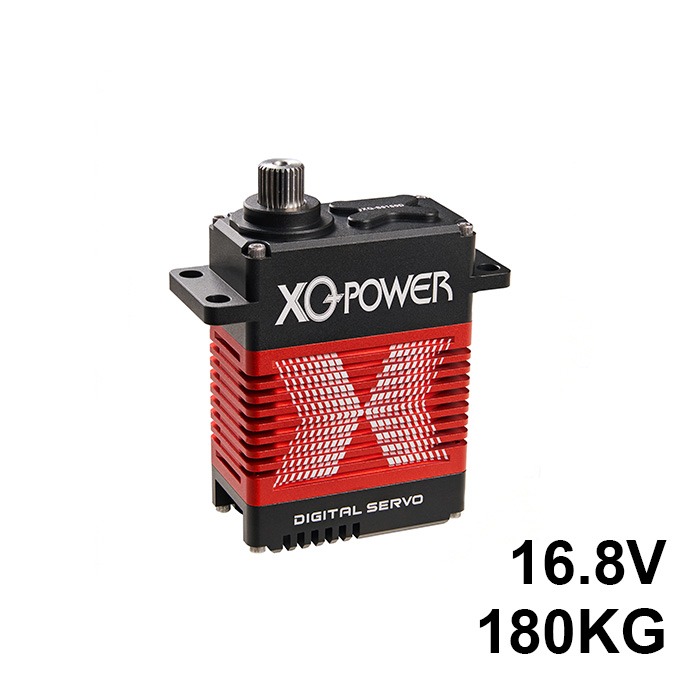
The XQ-Power engineering team has delivered custom high-temperature variants of the S9150D platform for industrial furnace damper control, using SH-grade magnets, Class H windings, and polyurea-greased bearings. The thermal derating curve for these units shows approximately 15% torque reduction at 100 degrees C ambient compared to 25 degrees C — the penalty for pushing into the thermal frontier. That derating must be factored into sizing calculations or you’ll end up with a servo that holds position on paper but stalls under load in the field.
If you’re specifying servos for an environment above 80 degrees ambient, don’t start with catalog parts. Start a conversation about magnet grades, bearing grease specs, insulation class, and cooling strategy. The right high temperature servo motor costs more upfront but it’s the only kind that survives.