
In the IoT era, the reliability of a smart lock is defined less by its Wi-Fi stack and more by the small actuator that turns the cylinder inside the door. For hardware engineers selecting cylinder actuator drives, one datasheet figure dominates the decision: stall torque. Specify too little, and the lock stalls against a warped door frame; specify too much, and the motor wastes battery, generates heat, and beats up its own gear train. This guide explains how to determine the ideal stall torque for smart lock actuators, the mechanical factors that drive the requirement, and the safeguards every good drive design needs beyond the stall torque number.
Direct Answer: Torque Requirements for Smart Locks
Verdict for hardware engineers: for typical residential deadbolts, spec a cylinder actuator drive with 1.5-3.0 kgf·cm (approx. 0.15-0.30 N·m) of stall torque at the cylinder interface, a stall-tolerant duty cycle below 10%, and firmware that cuts power within 3-5 seconds of a stall event. High-security mortise and commercial locks generally require 4.0 kgf·cm or more. Pick the lowest stall torque that clears the worst-case friction you measure on real door hardware, add a 20-30% safety margin for temperature swing and component wear, and resist the urge to oversize for peace of mind.
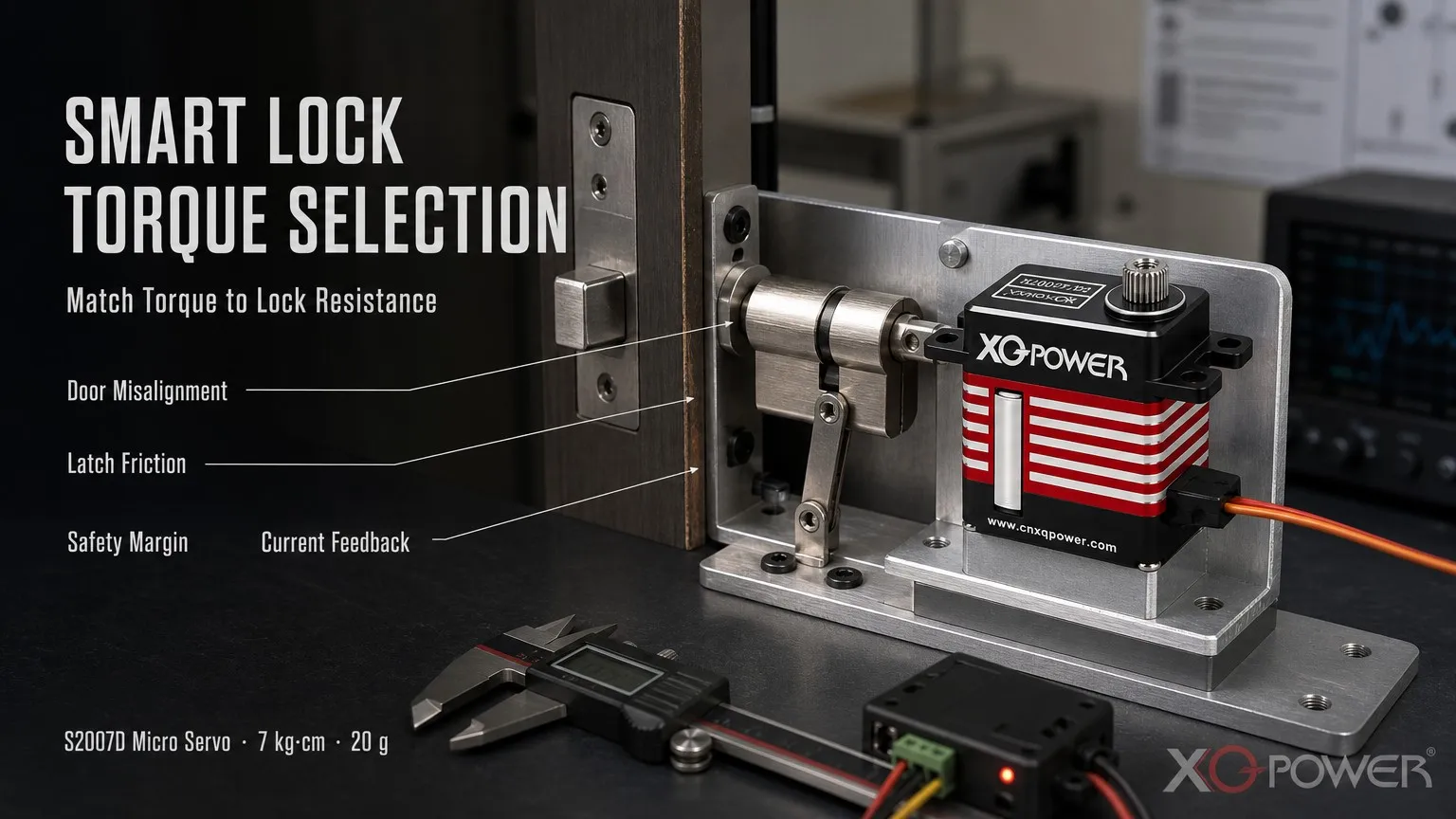
1. Factors Defining Mechanical Resistance
- Door-Frame Misalignment – Settling, warping, paint build-up and latch friction can raise the effective resistance far above the ideal bench value.
- Temperature and Seasonal Contraction – Cold weather thickens grease and shrinks clearances, while heat softens seals; both shift the real-world torque demand.
- Weatherstripping and Seal Drag – High-IP lock housings add gaskets whose compression force must be overcome on every single cycle.
- Battery Voltage Sag – As cells age or chill, terminal voltage drops, cutting available current and effectively shrinking usable stall torque when the door needs it most.
2. Selection Matrix: Payload vs. Performance
| Lock Application | Recommended Stall Torque | Typical Drive | Key Design Consideration |
|---|---|---|---|
| Cabinet / drawer lock | 0.3-0.8 kgf·cm | 6-8 mm micro gearmotor | Lowest cost, short burst duty |
| Residential deadbolt | 1.5-2.5 kgf·cm | 10-12 mm DC geared motor | Balance battery life, noise and speed |
| Mortise / high-security lock | 2.5-4.0 kgf·cm | 12-16 mm planetary drive | High cycle count, stall detection |
| Commercial / multi-point lock | 4.0-6.0 kgf·cm | 16 mm+ drive with encoder | Current limiting plus telemetry |
3. Engineering Safeguards: Beyond the Stall Torque
- Thermal Runaway – Stall current drives winding temperature up in seconds; include current limiting or a thermal cutoff so the drive releases before the insulation degrades.
- Gear Train Stress – Repeated stalls hammer gear teeth and can strip plastic pinions; derate the gearbox and specify metal final stages for high-cycle locks.
- Telemetry Feedback – Hall-effect position and current sensing let firmware detect, retry and report stall events, turning raw torque data into predictive maintenance.
Frequently Asked Questions
No. Higher stall torque draws more current, generates more heat, and demands a stronger, heavier and costlier gear train. It also raises the risk of mechanical damage when the actuator slams into a hard end stop. The right stall torque is the smallest value that reliably overcomes the worst-case mechanical resistance of your specific door and lock hardware, plus a controlled safety margin of roughly 20-30%.
Winter failures are almost always a friction problem, not an electronics problem. Low temperatures thicken grease, contract metal clearances, and reduce battery capacity, often by 30% or more. Together these effects push torque demand above what the actuator can deliver at reduced voltage. Mitigations include low-temperature lubricants, wider clearance tolerances, and a stall torque rating sized for the cold-soaked worst case rather than a 25°C lab bench.
Yes. XQ-POWER engineers custom gear ratios, output shafts and stall characteristics for smart lock actuator drives, from 6 mm micro gearmotors to high-torque planetary drives with integrated encoders. Our team can match speed, torque, noise and duty-cycle requirements to your lock mechanism and validate samples on your door hardware. Send us your target torque curve and we will recommend a configuration.
Conclusion: Reliable Access Starts with the Right Drive
Choosing the ideal stall torque for a cylinder actuator drive is about matching worst-case mechanical resistance with controlled electrical margin, not about buying the biggest motor in the catalog. Spec for the door the lock will actually live on, protect the drive with current limits and gearbox derating, and let telemetry keep teaching you about the field. XQ-POWER (XQPOWER) engineers smart lock actuator drives from 6 mm micro gearmotors to high-torque planetary systems – explore the product range or talk to our engineering team about your cylinder actuator project.