
Choosing between brushed and brushless servos is one of the most common decisions engineers face when designing motion-control systems. Both technologies have earned their place in industrial applications, but the right choice depends on your performance targets, operating environment, lifecycle cost, and maintenance philosophy. This guide breaks down the engineering differences between brushed and brushless servos, gives you a fast selection rule, and walks through real-world scenarios so you can match the technology to your payload and duty cycle with confidence.
The Verdict: Quick Selection Rule
Direct answer: choose brushless servos for high-speed, high-duty-cycle, continuous-operation applications where efficiency, longevity, and precision matter most; choose brushed servos for simple, low-cost, low-speed, or short-life designs where upfront price and ease of control are the priority. As a rule of thumb, if the application runs more than a few hours a day or requires maintenance-free operation, brushless wins. If it is a budget prototype, a one-off machine, or a low-speed positioner with modest cycle counts, brushed remains the practical, reliable workhorse.
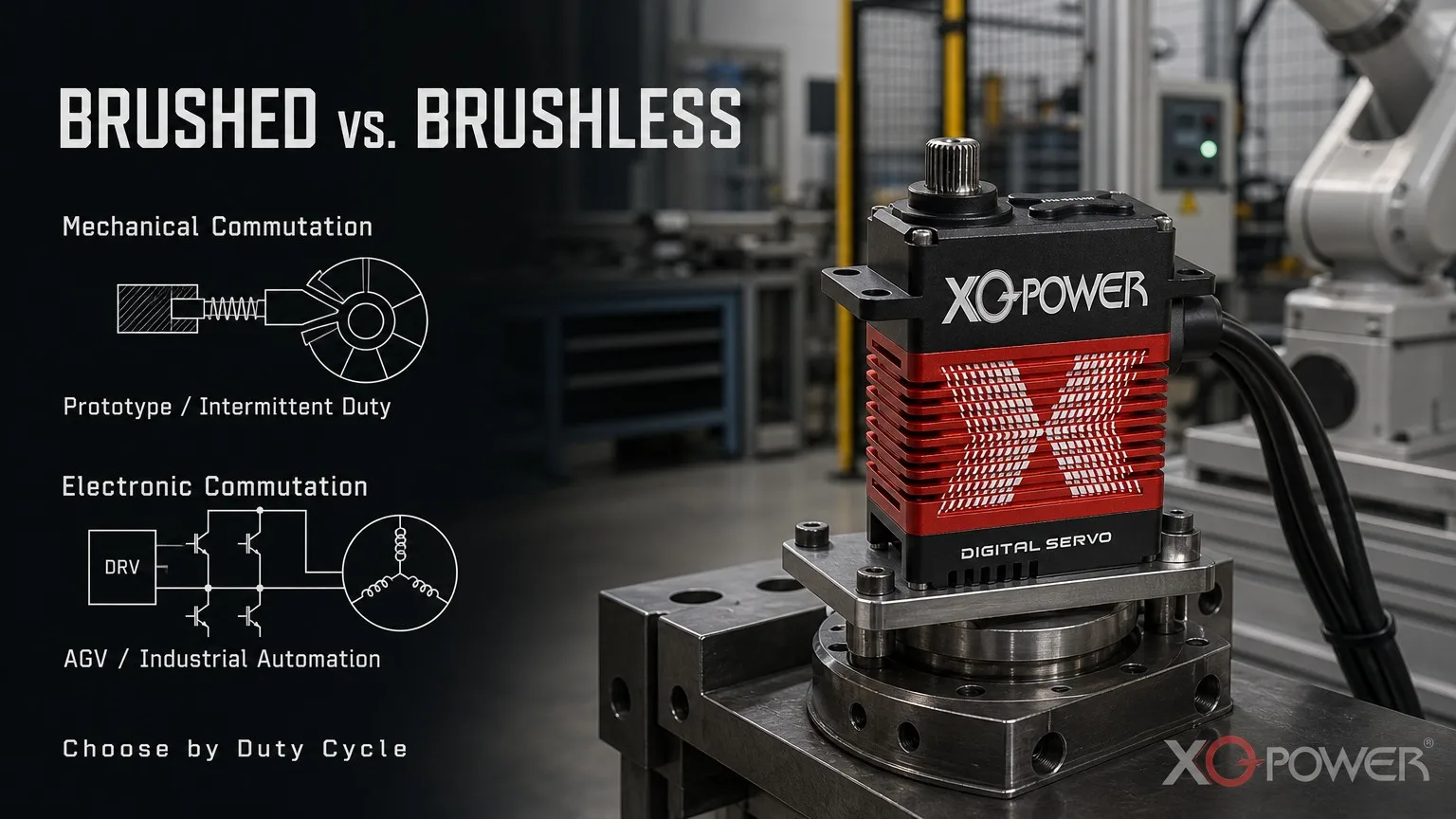
1. Technical Comparison: Brushed vs. Brushless
Understanding the internal architecture is key to making the right choice. A brushed servo motor relies on a mechanical commutator and carbon brushes to switch current in the rotor windings, which makes it simple to drive with a basic amplifier or even a DC power stage. A brushless servo motor, by contrast, uses electronic commutation: permanent magnets sit on the rotor while the stator windings are switched by the controller in sequence, eliminating physical contact, sparking, and brush wear. That single architectural difference drives every downstream trade-off — lifespan, efficiency, torque density, heat behavior, maintenance intervals, and control complexity — summarized in the table below.
| Joint Position | Primary Requirement | Priority Ranking | XQ-POWER Recommended Features |
|---|---|---|---|
| Leg Joints | Weight Support & Impact Resistance | Torque > Holding Power > Durability | Large Reduction Ratio, Steel Gears, High Peak Torque |
| Wrist Joints | Pose Adjustment & Precision | Speed > Size > Response Time | High RPM, Lightweight, Compact Form Factor |
2. Why Choose Brushed? (The Reliable Workhorse)
- Lowest upfront cost — ideal when budget dominates the BOM.
- Simple control — can be driven by a basic analog amplifier or PWM; no encoder feedback required for many positioners.
- Robust and proven — decades of field data in automotive, hobby, and light automation.
- Forgiving of dirty, humid environments where sensitive brushless electronics would be stressed.
- Easy field repair — brushes are a consumable any technician can replace in minutes.
3. Why Upgrade to Brushless? (The Industrial Powerhouse)
- 3–10× longer service life — no mechanical brushes means no wear items and far fewer downtime events.
- Higher efficiency and torque density — more torque per frame size, cooler operation, smaller motors for the same job.
- Faster dynamics — higher acceleration, wider speed range, and tighter settling for demanding motion profiles.
- Minimal maintenance — sealed, maintenance-free construction built for 24/7 production lines.
- Better thermal behavior — heat is generated in the stator where it can be conducted away through the housing.
- Lower noise and EMI — no sparking, cleaner signals for sensitive electronics and easier EMC compliance.
4. Selection Guide: Matching Payload to Technology
Scenario A: Prototyping & Budget-Driven Projects
For a first prototype, an academic rig, or a product where the selling price is the dominant constraint, brushed servos are usually the smart choice. The motor and drive electronics are dramatically cheaper, integration takes hours instead of days, and a handful of brush replacements over the project life is an acceptable trade. Reserve your engineering budget for the parts of the system that create differentiation — a correctly sized brushed servo will carry a prototype through hundreds of hours of iteration without complaint.
Scenario B: 24/7 Industrial Automation & AGVs
Continuous-operation machinery — packaging lines, CNC feeders, pick-and-place cells, and automated guided vehicles — punishes brush wear relentlessly. Here brushless servos pay for themselves quickly: elimination of brush maintenance, higher efficiency that cuts energy bills and heat load, and sealed construction that shrugs off dust and washdown. Total cost of ownership over a three-to-five-year horizon almost always favors brushless, and the improved dynamic response directly raises machine throughput.
Scenario C: High-Frequency & Shock Loads
Applications with rapid reversal, frequent start-stop cycles, or impact and shock loading stress mechanical commutation the hardest — brush bounce, sparking, and accelerated wear are the symptoms. A brushless servo with electronic commutation and closed-loop control absorbs these transients gracefully, delivers consistent torque under load, and maintains position holding even during momentary overloads. If your machine sees high-frequency duty cycles or shock loads, brushless is not a luxury; it is the engineering-safe choice.
Frequently Asked Questions
A brushed servo motor commutates current mechanically through carbon brushes and a commutator on the rotor, while a brushless servo motor commutates electronically, switching stator windings via a controller and using permanent magnets on the rotor. This makes brushless motors more efficient, longer-lived, and lower-maintenance, at the cost of requiring more complex drive electronics and a higher upfront price.
In most industrial applications, yes. The longer service life, higher efficiency, lower maintenance burden, and better dynamic performance typically deliver a lower total cost of ownership within one to three years — and they keep running long after a brushed motor would have needed its first brush replacement.
Brushed servo motors typically last 1,000 to 3,000 operating hours before the brushes need replacement, depending on speed and load. Brushless servo motors routinely exceed 10,000 hours — and often 20,000 hours or more — with no wear-related maintenance, limited mainly by bearing life.
Conclusion: Engineering for Success
Choosing between brushed and brushless servos is ultimately a systems-engineering decision: weigh duty cycle, environment, lifecycle cost, and control architecture before you buy. For prototyping and budget-driven builds, brushed servos remain the reliable workhorse; for 24/7 automation, AGVs, and high-frequency loads, brushless technology is the industrial powerhouse that pays for itself. Browse our full range of industrial servo motors and drives at XQ-POWER, and contact our engineering team to get a sizing recommendation tailored to your payload and duty cycle.