
Direct answer: XQ-POWER brushless servos can offer a stronger thermal-control foundation for repeated high-load operation because a brushless motor removes brush-contact friction, while a metal gear train and conductive housing can support heat transfer away from the drive system. In a complete application, thermal stability also depends on operating voltage, working torque, duty cycle, mounting, ambient conditions, airflow, and controller settings. A product should therefore be selected and validated at the intended load—not judged by motor type alone.
At-a-Glance Thermal Takeaways
- Brushless construction removes mechanical brush contact and its associated friction and wear mechanism.
- Metal gears support load transmission, but the gear train, bearings, motor, driver, and housing must be evaluated as one heat-producing assembly.
- A conductive aluminum housing can provide a useful heat path when the mounting structure can accept and dissipate that heat.
- Continuous high torque is a thermal condition, not only a torque condition: current, duty cycle, holding time, and cooling path all matter.
- Temperature monitoring or protection may be available on selected drive configurations; confirm the exact function, threshold, and response for the selected model.
- Waterproof or splash-resistant construction does not automatically mean unlimited high-load operation. Sealing, heat transfer, and application duty must be validated together.
Why High-Frequency Heavy Loads Create Servo Heat
A servo generates heat whenever electrical power is converted into mechanical output and whenever the drive must hold position against a load. During a high-frequency motion profile, the actuator repeatedly accelerates, decelerates, changes direction, and corrects position. During a heavy holding task, current can remain elevated even when the output shaft appears stationary.
The resulting heat is distributed across several areas:
- The brushless motor windings;
- The electronic driver and power components;
- The gear train and bearings;
- The output-shaft support structure;
- The housing and mounting interface.
This is why a short peak-torque figure does not describe the thermal behavior of a servo in a production mechanism. A high-load application should define its working torque, peak torque, holding torque, motion frequency, dwell time, ambient temperature, and available cooling path.
XQ-POWER’s technical guide describes servo sizing, torque selection, encoder choices, communication protocols, waterproofing, and thermal management as connected engineering questions. That systems-level approach is more useful than treating heat as an isolated motor specification.
How Brushless Motor Design Reduces One Source of Loss
A brushed motor uses mechanical contacts between brushes and a commutator. Those contacts introduce friction, electrical wear, contact variation, and additional heat-generation mechanisms. A brushless motor uses electronic commutation instead of brush contact, so it removes that specific mechanical wear interface.
The practical benefit is not that a brushless servo produces no heat. Copper loss, switching loss, bearing friction, gear friction, and control effort still produce heat. The benefit is that the motor no longer relies on a continuously rubbing brush interface, which can be valuable in applications with frequent reversals, repeated positioning, or long operating cycles.
XQ-POWER’s product range includes a dedicated brushless servo category, covering compact and high-torque industrial models. The appropriate selection still depends on the required voltage, output torque, speed, dimensions, interface, load profile, and environmental conditions.
What brushless construction does—and does not—solve
It can help with:
- Removing brush-contact friction and brush wear;
- Supporting repeated commutation without a mechanical brush interface;
- Improving suitability for long-cycle motion when the model is correctly sized;
- Providing a platform for electronic monitoring and protection functions.
It does not automatically solve:
- Excessive continuous current;
- An undersized gear train;
- Poor heat transfer from the housing;
- High bearing or linkage side loads;
- Incorrect voltage or control parameters;
- Insufficient cooling in a sealed installation.
The thermal result comes from the complete servo and mechanism, not from the word “brushless” alone.
How Metal Gears and the Housing Affect Heat Transfer
In a high-torque servo, the gear train carries the mechanical load and contributes to the internal friction budget. Metal gears can provide a robust load-transfer path for demanding applications, but they do not eliminate gear friction or the need for lubrication, bearing support, correct alignment, and adequate thermal design.
The housing is also part of the heat path. A metal or aluminum housing can conduct heat from internal components toward the outer surface and mounting points. That benefit is strongest when the housing is mounted securely to a structure that can accept the heat. A servo surrounded by insulating material or installed in a confined pocket may have less effective heat rejection even if its housing is conductive.
For a high-load installation, review:
- Whether the housing contacts a rigid mounting plate;
- Whether the mounting plate has a path to the surrounding air or chassis;
- Whether the bracket blocks the housing’s available heat-transfer surface;
- Whether the mounting screws are secure without distorting the case;
- Whether the external mechanism adds side load to the output shaft;
- Whether cable routing or protective covers trap heat around the driver.
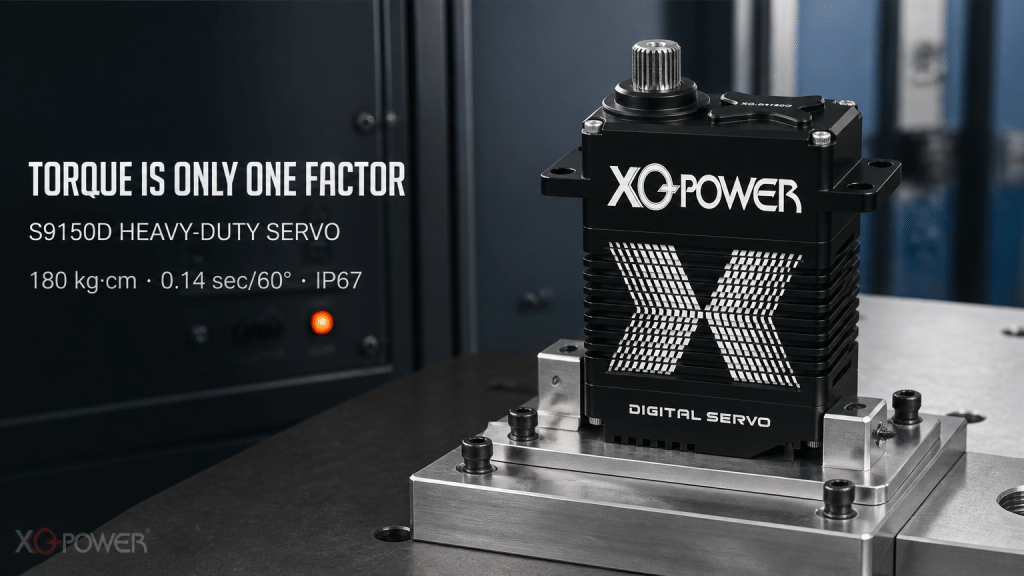
XQ-POWER’s S9150D 180kg industrial brushless servo page is an example of the type of high-torque product page engineers can review when comparing application scale and mechanical integration. Do not transfer its specifications to another model without checking that model’s own datasheet.
How Temperature Monitoring and Protection Can Improve Stability
A driver board with temperature monitoring or thermal protection can add an important control layer to a high-load servo. Depending on the selected model and configuration, a thermal function may monitor an internal temperature signal, trigger a warning, reduce output, or protect the drive from an unsafe condition.
These functions should be treated as protection and diagnostic tools—not as permission to operate continuously beyond the design envelope. If protection activates, the underlying cause may be excessive load, insufficient cooling, incorrect voltage, repeated reversals, blocked movement, high friction, or an external mechanical alignment problem.
Before using a model in a production system, confirm with XQ-POWER:
- Whether temperature monitoring is present;
- Which component or region is monitored;
- Whether the system reports temperature through the communication interface;
- What protective response is used;
- Whether the response is a warning, derating action, shutdown, or fault state;
- How the controller should recover after a thermal event.
Engineering validation note: The XQ-POWER pages reviewed for this article do not establish one universal temperature threshold or one universal thermal derating curve for every brushless servo. Thresholds, telemetry, and protection behavior are model-specific and require confirmation.
Why Continuous Torque Matters More Than a Short Peak Number
A servo may reach a large peak torque for a short interval while remaining unsuitable for continuous high-load holding. In a high-frequency mechanism, the relevant thermal question is how much current the servo draws over the complete motion cycle and how quickly the system can remove the resulting heat.
Separate the application into three load conditions:
Peak movement torque
This is the torque needed for acceleration, impact response, or a short load event. It influences current demand and mechanical stress.
Working torque
This is the torque required during normal motion. It should be evaluated at the real speed, acceleration, linkage geometry, and supply voltage.
Continuous holding torque
This is the torque required while the servo maintains position or pulls against a load for an extended period. It can produce sustained current and heat even when the mechanism is not visibly moving.
For a more detailed explanation of load terminology, engineers can review XQ-POWER’s high-torque servo application guide. The selected product must still be checked against its own continuous-duty requirements.
How to Control Heat in Repeated High-Torque Motion
Thermal performance is usually improved by reducing unnecessary current and improving the heat path. The following design actions are practical starting points:
Reduce mechanical resistance
Check bearing alignment, linkage friction, gear mesh, shaft side load, and mechanical end stops. A servo that fights a stiff or misaligned mechanism converts avoidable electrical power into heat.
Use the correct operating voltage
The controller and power supply must match the servo’s specified voltage range. Do not increase voltage to obtain speed without confirming the effects on current, driver stress, motor temperature, and gear loading.
Tune acceleration and reversal behavior
Aggressive acceleration, abrupt reversal, and high-frequency correction can increase current peaks. Tune the motion profile around the mechanism’s real inertia and required response time.
Provide a real mounting heat path
Mount the servo to a rigid structure when the model and mechanical design permit it. Avoid wrapping the case in insulating material or placing it in a sealed cavity without a thermal plan.
Separate load support from servo output where appropriate
If the external mechanism applies large radial or axial force to the output shaft, use independent mechanical support where appropriate. Reducing shaft deflection and friction can lower both mechanical wear and drive current.
Monitor the complete duty cycle
Record current, case temperature, ambient temperature, position behavior, fault events, and cycle count. A temperature snapshot after a short test does not describe a long high-frequency operating cycle.
How Waterproof Construction Changes Thermal Design
A sealed or waterproof servo introduces a design trade-off. Sealing can protect the internal system from rain, mud splash, or other environmental exposure, but it can also limit airflow and change the route by which heat leaves the housing.
XQ-POWER presents waterproof brushless servos for subsea ROV applications and lists waterproof brushless servo products on its homepage. For a rain, mud, or splash-exposed mechanism, engineers should evaluate both environmental protection and heat rejection.
The key questions are:
- Is the housing surface exposed to air or attached to a conductive chassis?
- Does the protective cover trap heat around the case?
- Does the water or mud environment change the external heat-transfer condition?
- Can contamination increase mechanical friction or block moving interfaces?
- Is the servo being used within its specified environmental and duty-cycle limits?
- Does the application require periodic inspection after high-load operation?
A waterproof construction should not be described as proof that a servo will remain cool at any load. Conversely, a sealed housing is not automatically thermally unsuitable. The answer depends on the model, mounting, ambient condition, load, and validated test profile.
How to Validate Thermal Stability Before Deployment
A reliable thermal test should reproduce the complete mechanism rather than testing the servo with no external load. Use the intended voltage, mounting arrangement, linkage, load, communication method, and cycle profile.
Baseline test
Record ambient temperature, supply voltage, no-load current, loaded current, output behavior, and initial case temperature. Confirm that the servo reaches the commanded position without abnormal noise or correction.
Repeated-motion test
Run the real acceleration, travel, reversal frequency, dwell time, and cycle count. Include the loads created by the mechanism rather than using only a free-air servo horn.
Continuous-hold test
Hold the output at the required working torque for the expected dwell time. Track current and case temperature at regular intervals. A stable position does not prove that internal temperature is stable, so the thermal profile must be observed over time.
Environmental test
If the product will operate in rain, mud splash, or another exposed environment, reproduce the relevant condition without changing the intended electrical or mechanical test variables. Inspect the housing, cable exit, bearings, gears, and output shaft after testing.
Recovery and fault test
If the model provides thermal monitoring or protection, confirm how the system behaves when the protection function activates. Verify the controller’s fault handling, restart behavior, and safe-state response.
Engineering validation note: Acceptance limits, allowable case temperature, thermal shutdown behavior, and service-life claims must be defined by the responsible engineering team and confirmed for the selected model.
When XQ-POWER Brushless Servos Are a Practical Fit
XQ-POWER’s brushless servo portfolio is relevant to applications that combine high torque, repeated motion, precise positioning, and demanding installation conditions. Potential use cases include industrial automation, robotics, UAV mechanisms, heavy-duty actuators, and other systems where a brushed motor’s contact wear would be undesirable.
For product selection, start with the high-torque servo category and compare the model-level data for torque, voltage, speed, dimensions, gear construction, feedback, communication, environmental protection, and duty cycle. If the standard product does not match the mechanism, XQ-POWER’s homepage directs engineers to share the application scenario and key requirements for product recommendation or customization.
Frequently Asked Questions
A brushless servo removes the mechanical brush-contact interface, reducing one source of friction and wear. It can still generate heat through winding losses, switching losses, gears, bearings, and continuous control effort, so the complete duty cycle must be validated.
No. Metal gears can support load transmission, but gear friction, bearing load, motor current, housing heat transfer, and the external mechanism still affect temperature. Metal construction is one part of the thermal and mechanical design.
No. Temperature monitoring or protection can help detect or limit an unsafe condition, but it cannot replace correct torque sizing, voltage matching, mechanical alignment, and heat-path design. The exact protection behavior is model-specific.
Not necessarily. Water or an attached chassis may change heat transfer, while sealing can reduce airflow. Mud, contamination, and increased mechanical friction can also add load. The actual model and installation must be tested in the intended environment.
Measure supply voltage, current, ambient temperature, case temperature, motion cycle, holding time, position behavior, fault events, and mechanical noise. If available, also record internal temperature or telemetry through the servo’s supported interface.
Provide the required torque, speed, voltage, dimensions, communication protocol, motion profile, duty cycle, ambient conditions, mounting arrangement, environmental exposure, and target service life. XQ-POWER can then review the application and confirm the suitable model or custom configuration.
Conclusion: Thermal Control Is a System-Design Result
The thermal advantage of an XQ-POWER brushless servo comes from the interaction of brushless motor construction, mechanical load transmission, housing heat paths, drive electronics, monitoring functions, and the way the servo is installed. Reducing brush friction is useful, but it is not a substitute for correct sizing and validation.
For high-frequency heavy-load operation, define the continuous torque, peak load, operating voltage, cycle profile, cooling path, environmental exposure, and protection behavior before deployment. Then test the complete assembly at the intended load. That is the reliable way to determine whether a brushless servo will maintain stable output without thermal derating or an unexpected shutdown.