
Closed Loop Servo Control: The Difference Between “Moved” and “Arrived”
Closed loop servo control is the difference between guessing and knowing — here’s a simple test. Tell an open-loop stepper motor to rotate 90 degrees. Now put a 5kg load on its shaft and tell it the same thing. Did it actually go 90 degrees? You don’t know. The controller sent the pulses. The motor made noise. Whether the shaft reached the commanded position is anyone’s guess. That’s the fundamental problem that closed loop servo control solves.
In an open-loop system, the controller issues commands and assumes they were executed. No verification. No correction. If the load exceeds the motor’s torque capacity for even a fraction of a second, you get a missed step and a permanent position error. For a 3D printer making decorative objects, a missed step ruins a print. For an AGV steering servo that missed 2 degrees at the wheel, it means the vehicle drifts 50mm sideways per meter of travel and eventually crashes into a rack.
1
Closed loop servo control adds one critical component: a position sensor that continuously reports the actual shaft angle back to the controller. The controller compares commanded position against actual position in real time — typically at 50Hz to 500Hz depending on the servo’s control loop speed — and adjusts motor current to minimize the error. If the load pushes back, the servo pushes harder. If the load suddenly drops, the servo backs off instantly. The motor doesn’t just move; it arrives at the commanded position and holds it.
2
The PID control algorithm drives most closed loop servos. Three terms work together: Proportional responds to current error, Integral accumulates error over time to eliminate steady-state offset, and Derivative anticipates future error based on rate of change. Tuning these three gains is where closed loop servo control becomes an art. Too much P-gain and the servo oscillates around the target position. Too much I-gain and it overshoots then hunts back and forth. Too much D-gain and it becomes sluggish, fighting its own damping.
3
Industrial applications almost universally demand closed loop operation. A conveyor gate that needs to open to exactly 87 degrees for a specific package size can’t afford open-loop uncertainty. A robotic arm joint holding a welding torch at a precise angle cannot tolerate drift. A solar tracker following the sun across an 8-hour window accumulates massive error without position feedback. Each of these scenarios requires closed loop servo control with position verification happening dozens or hundreds of times per second.
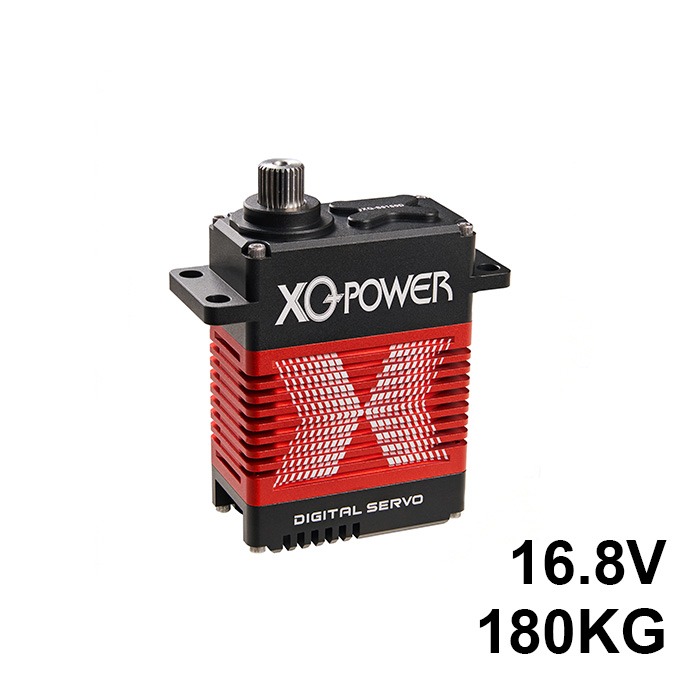
The XQ-Power S8335DW and S9150D both use 12-bit magnetic encoder feedback running closed loop at 333Hz. That means position is checked and corrected every 3 milliseconds. In practice, this translates to positioning repeatability under 0.1 degrees even after thousands of cycles. For an engineer specifying components for an automation cell, that number matters more than the peak torque rating on the datasheet.
4
One common misconception: brushless motors are not automatically closed loop. The brushless commutation itself uses Hall sensor feedback to sequence the phases, but that’s motor commutation, not position control. True closed loop servo control requires a separate position encoder feeding back to a controller that compares actual vs commanded position. Without that loop, even a brushless motor is just guessing.
If your application requires guaranteed position accuracy — not just motion — closed loop is not optional. It’s the baseline.