
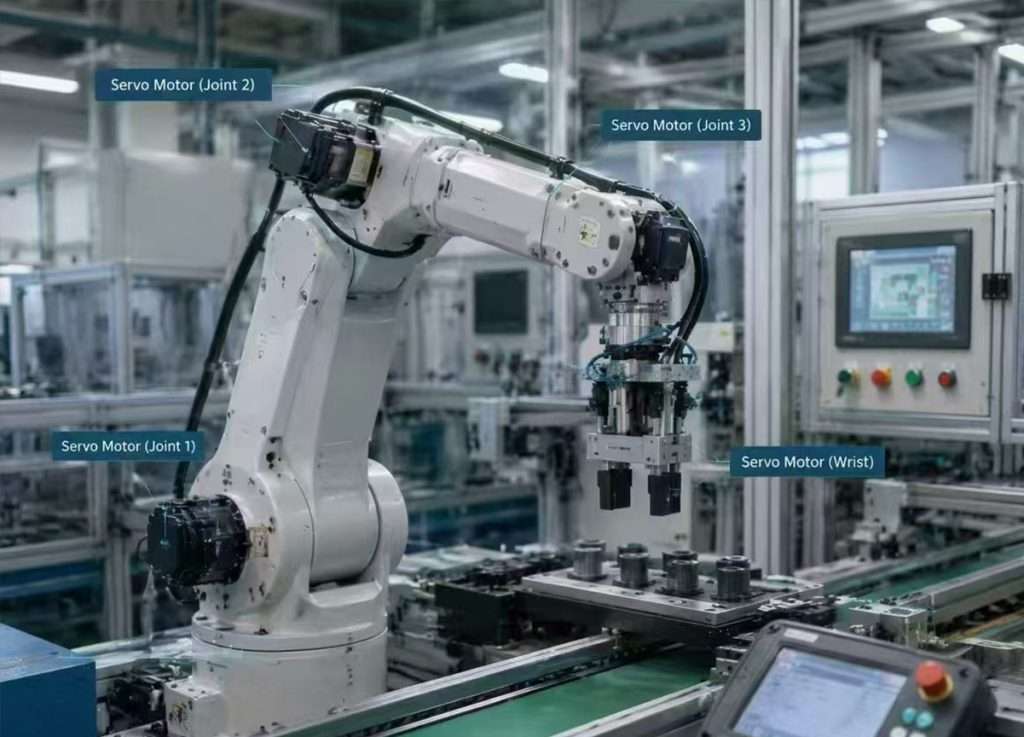
Precision Actuators are the foundation of any high-performance multi-axis robotic arm system used in industrial assembly. “We needed a deadband of nearly zero to maintain sub-millimeter accuracy,” explained a lead robotics researcher we worked with last month. This level of control is not optional for modern labs. It is a strict requirement for repeatable task execution.
Solving the Deadband Challenge
In a multi-axis setup, even tiny errors in one joint will multiply down the line. This is why Precision Actuators must have minimal deadband. If the servo motor hesitates before moving, the end-effector will miss its target. We focus on high-resolution magnetic encoders to solve this. Our S8335DW series, for instance, uses a 14-bit encoder system. This allows the arm to sense its position with extreme clarity. It eliminates the “hunting” behavior common in cheaper actuators.
Dynamic Response and Gear Backlash
Accuracy is not just about electronics. It is also about the mechanical link. Standard gears often have too much play, or backlash. For robotic arms, this play ruins the precision of the entire kinematic chain. We use hardened steel gear sets in our Precision Actuators to minimize this wear. This ensures that the arm remains tight even after thousands of cycles. A robotic arm is only as good as its weakest joint. Keeping every connection rigid is key to success.
Implementing S8335DW in Complex Tasks
When we act as a technical partner, we often help clients with PID tuning. The dynamics of a multi-axis arm change based on its payload. A heavy tool at the end of the arm increases inertia. Our S9150D models allow for real-time parameter adjustments via serial protocol. This flexibility lets engineers optimize the damping for different tasks. You can reach high speeds without overshooting the final position. This balance of speed and control is what defines a true industrial-grade system.
You can find more detailed specs on our robotic actuator lineup or check out our recent project case studies in the Engineering Capabilities Hub on our site.