
I’ve pulled apart enough seized servos to know exactly what saltwater does. The failure is always the same pattern. Water creeps past the output shaft seal after a few dozen thermal cycles. Then the potentiometer track corrodes. Position feedback gets noisy, then erratic, then gone. By the time you see jitter on the control surface, the damage is done — you’re looking at a full rebuild, not a cleaning.marine grade servo
The frustrating part is that most of these weren’t cheap units. They were decent industrial servos with an IP65 rating, run on ROVs that never went below 20 meters. IP65 means “protected against water jets,” not “submerge me daily in the North Sea.” That’s a spec sheet reading problem, not a servo problem.
What Marine Grade Actually Means
The term gets thrown around loosely. A marine grade servo needs three things that most standard units skip entirely.
O-ring seals on every penetration point. Output shaft, case screws, cable gland. Not one gasket that “covers most of it” — individual seals at each opening. If water gets past the shaft seal, the electronics are still protected because the case screws are independently sealed.
Conformal coating on the PCB. This is a thin polymer layer sprayed over the circuit board that prevents salt creep from bridging traces. Saltwater doesn’t need to submerge the board to kill it. A single droplet that dries and leaves a conductive salt bridge between two adjacent pads is enough. Conformal coating prevents that.
Galvanic isolation between dissimilar metals. Aluminum case, steel gears, brass inserts — when saltwater bridges these, you’ve got a battery. The least noble metal corrodes preferentially. Marine grade servos either use compatible metal pairs or isolate them with non-conductive barriers.
IP67 vs IP68
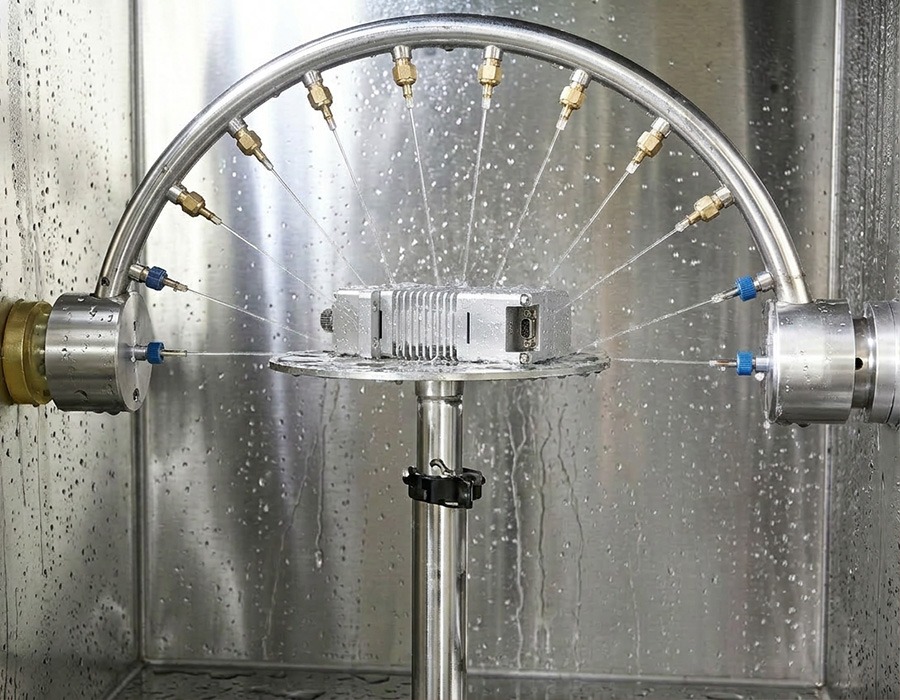
These numbers actually mean something specific. IP67 is 30 minutes at 1 meter depth. IP68 is whatever the manufacturer says it is — there’s no fixed depth or duration in the standard beyond “more than IP67.” So when a spec sheet says IP68 without stating test conditions, you have no idea if that means 2 meters for an hour or 50 meters for a week.
For ROV thrust vector control at recreational depths, IP67 is usually fine. The actuator sees splash and occasional brief submersion. For anything that lives underwater for a full mission cycle, ask the manufacturer for the specific IP68 test parameters. If they can’t tell you, it’s IP67 with better marketing.
The Potentiometer Problem
Magnetic encoders have mostly solved this, but it’s worth understanding why. A traditional potentiometer uses a wiper dragging across a resistive track. Add salt crystals to that interface and the track wears mechanically, not just electrically. The resistance values drift, then the servo oscillates as the control loop fights bad data.
Hall-effect magnetic sensors have no contact. A magnet rotates above a sensor chip, the chip reads angular position, and the whole thing lives under conformal coating. No wiper, no track, nothing to wear. This alone increases the useful life of a marine servo by 3-5x over potentiometer-based units in saltwater environments.
XQ-Power’s IP67-rated servos use magnetic encoders across the board for this exact reason. The seals keep water out most of the time. When they eventually don’t, the internals survive because there’s nothing to corrode on the feedback side.
Related: Titanium Gear Servo: Worth the Weight Trade-off