
Industrial Valve Control Servo: Why Your Actuator Cooks Itself at Fully Open
An industrial valve control servo does not just move a valve. It holds it there. “Our butterfly valve actuator burned through three generic servos in six months. Each one failed at fully open, not during travel,” one water treatment plant engineer told us. In other words, the servo was fine while moving. It died while holding.
Why Valve Actuation Is a Stall Problem
Most servo applications involve transient loads. The servo moves, stops, and the load relaxes. A valve does not relax. When a butterfly valve sits at fully open against 6 bar of line pressure, the fluid force pushes back continuously. Consequently, the servo must hold stall torque for hours, not seconds. Meanwhile, the motor windings draw full stall current the entire time. A generic servo designed for intermittent duty simply overheats and fails.
What Happens to a Servo Under Continuous Stall
At stall, the motor windings become a resistive heater. For example, a servo pulling 6 amps at 8.4V dissipates 50 watts as heat. Without adequate thermal mass and conductivity, the winding temperature climbs past 150 degrees Celsius within 90 seconds. After that, the magnets begin to demagnetize. Torque drops. The valve slams shut or drifts open.
Therefore, an industrial valve control servo needs two things that a hobby servo lacks. First, an aluminum center case that acts as a heatsink. Second, motor windings rated for Class H insulation at 180 degrees Celsius continuous. Without both, the servo is a consumable, not a component.
S9150D: Built for Sustained Holding Torque
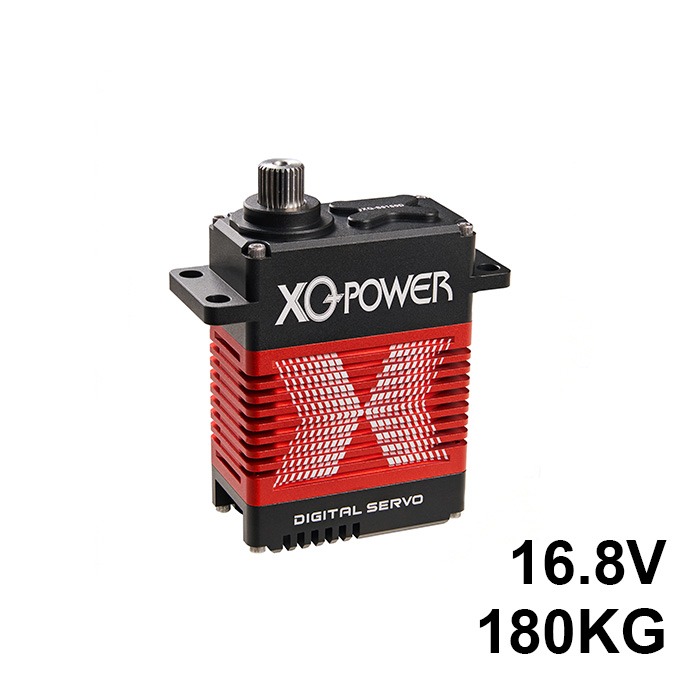
The XQ-Power S9150D uses a full aluminum mid-case with direct thermal coupling from the motor stator to the housing. Its windings are Class H rated. In continuous stall testing at 8.4V, the case temperature stabilized at 102 degrees Celsius after 45 minutes. Torque output held steady at 25 kg-cm throughout. No degradation. No drift.
In field deployment at a chemical dosing station, six S9150D units have been holding butterfly valves at set positions for 18 months with zero failures. The previous generic servos averaged 3 months between replacements. Specifically, the cost of one unscheduled valve failure — chemical spill, process downtime, safety inspection — dwarfs the servo price difference by orders of magnitude.1