
Why “High Power Density” is More Than Just a Buzzword in Servo Engineering
If you are designing a humanoid robot or a high-performance UAV, you are constantly fighting the Torque-to-Weight Ratio war. You need the highest possible output, but you have zero room for extra grams. This is where the term “High Power Density” comes in. But let’s be honest: in many datasheets, it’s just marketing fluff. To achieve true power density in a servo—not just a bare motor—you have to optimize the entire integrated system.
Here is how we approach high power density at XQ Power, and why it changes the way you design your hardware.
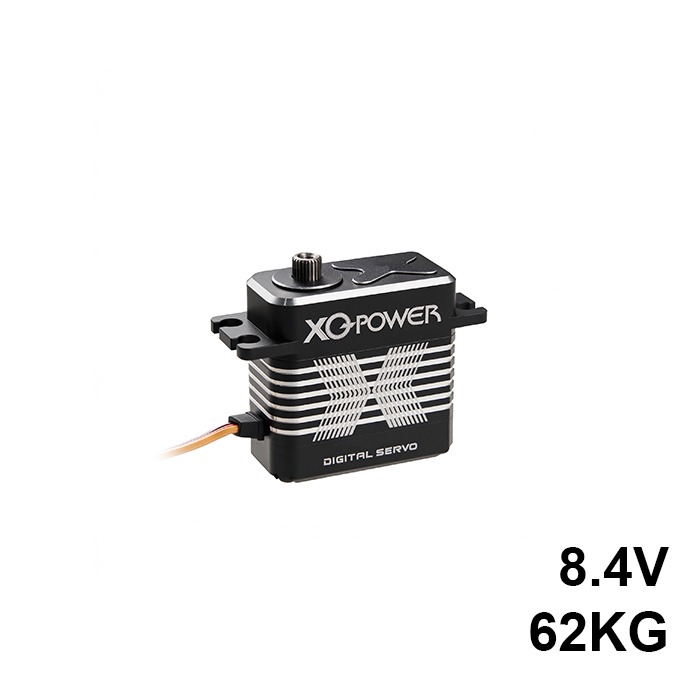
1. The Integration Advantage (Servo vs. Motor-ESC)
As we discussed in previous articles, a bare motor might have a high power rating, but by the time you add a gearbox, an encoder, and a motor controller (ESC), your “power density” has plummeted.
A high-density servo like our S9150D integrates all these components into a single, optimized footprint. By designing the controller PCB to fit perfectly around the motor housing and using the internal structure as a common ground, we eliminate the weight of external wiring and separate housings.
2. Material Science: Why CNC Aluminum 7075 Matters
Power density is limited by Heat. If you can’t get the heat out, you have to throttle the power.
Generic servos use plastic or thin-stamped metal cases. Under high load, these act like insulators, trapping heat inside and cooking the electronics. We use Full CNC-machined 7075 Aluminum for our mid-section and often the full housing.
- Thermal Conductivity: 7075 aluminum acts as a massive heat sink, drawing heat away from the brushless windings.
- Structural Integrity: It allows for tighter gear tolerances. When gears are aligned perfectly under load, friction is reduced, efficiency goes up, and “wasted” energy (which turns into heat) goes down.
3. Winding Density: The Heart of the Torque
To get more torque out of a small volume, you need more copper in the gaps. Our high-density servos use Multi-strand Parallel Winding techniques. This increases the “fill factor” of the motor stators.
More copper in the same space means lower internal resistance (DCR), allowing for higher current bursts without the voltage drop that plagues lower-density servos. This is how we achieve stall torques of 180kg.cm or even 250kg.cm in housings that used to only output half that.
4. The Engineering Trade-off: Efficiency vs. Raw Power
True power density is about Efficiency. A servo that consumes 100W to produce 50W of mechanical work is a heater. A servo that consumes 60W to produce 50W of work is a high-density actuator.
When you see an XQ Power servo, notice the efficiency curves. We optimize our gear ratios and motor KV together. By reducing the “drag” within the integrated system, we allow more of the battery’s energy to reach the output shaft.
Choosing Your Density
When your project reaches the stage where “standard” servos are too heavy or too weak, you aren’t just looking for a bigger motor. You are looking for a more efficient, better-integrated, and thermally-superior servo system.
At XQ Power, we don’t just push the limits of torque; we push the limits of what’s possible in a compact, reliable package.