
Why Servo Heat Dissipation Decides Reliability, Not Just Comfort
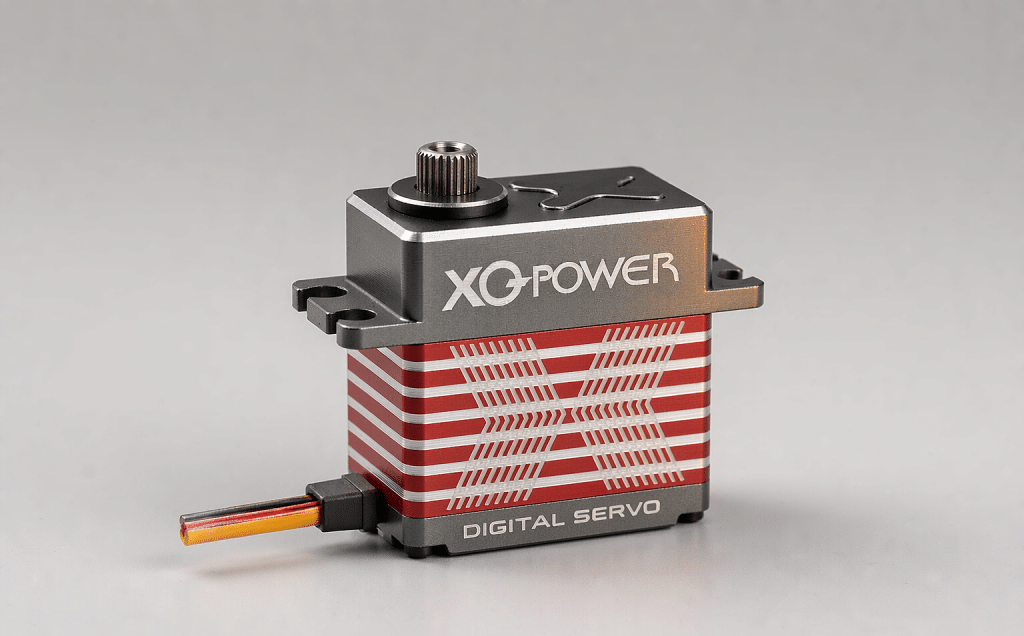
Most servo discussions focus on torque and speed. In practice, the number that quietly governs both is temperature. A servo holding a high torque draws continuous current, and a portion of that electrical energy becomes heat inside the motor windings, the driver, and the gear train. Understanding this is the basis of sound electrical machine rating practice, where a machine’s thermal class sets the temperature rise it is permitted to reach.
What sustained heat actually does to a servo
Once internal temperature climbs and stays high, several things happen at once:
- Losses rise further. Winding resistance increases with temperature, so the same torque needs more current, which produces more heat — a self-reinforcing loop if the servo is undersized.
- Position stability suffers. Differential expansion across the case, gears, and shaft changes gear mesh, and sensing accuracy can shift. (This behaviour is covered in more detail in our upcoming article on tiltrotor servo thermal drift.)
- Lubricant life shortens. Grease in the gear train degrades faster at elevated temperature.
- Component life shortens. Bearings, motor insulation, and driver electronics all age faster when they run hot.
That is why servo heat dissipation is treated as a design output at XQ-Power, rather than something left to the application to solve.
The Four Layers of XQ-Power Servo Heat Dissipation
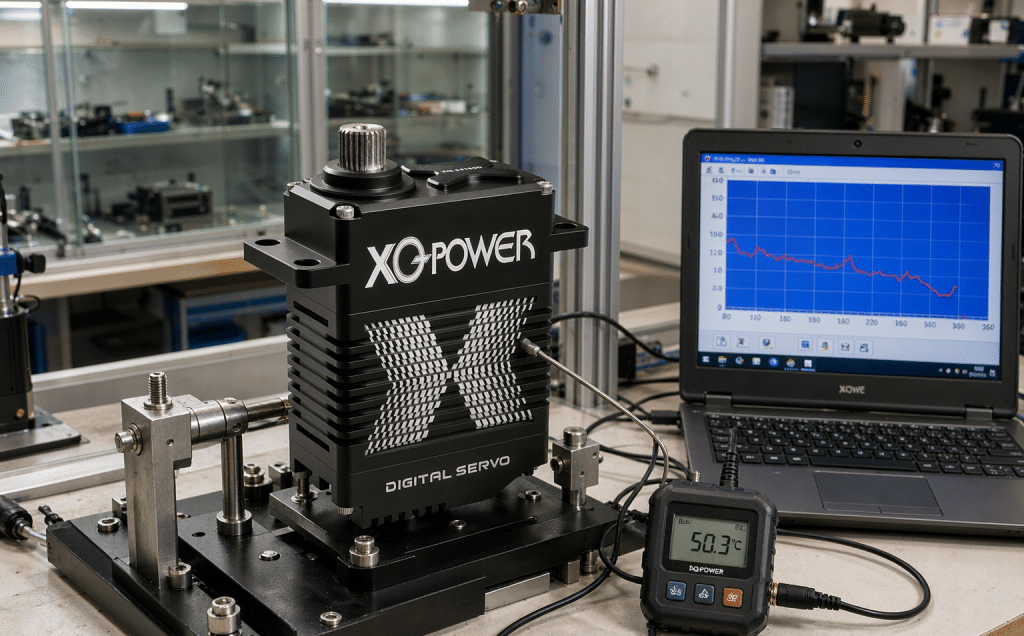
XQ-Power’s approach is deliberately layered: reduce the heat generated, give the heat a path to the outside, then spread it away from the servo. Each layer handles a different part of the problem.
Layer 1 — Brushless Motors: Generating Less Heat in the First Place
The most effective way to manage heat is not to create it. XQ-Power’s brushless motor series replaces the mechanical commutation of a brushed motor with electronic commutation, which removes brush friction and the losses associated with it. Less mechanical loss means less heat generated at the same output, which matters most in applications that run continuously rather than in short bursts. You can see the range in the XQ-Power brushless servo motor collection.
Fewer losses at the source has a compounding benefit: because the servo runs cooler, winding resistance rises less, so the current needed to hold the same torque stays lower — and the heat generated stays lower still.
Layer 2 — Stator-to-Case Thermal Coupling: Giving Heat a Way Out
Generating less heat is only half the task. The other half is removing the heat that is generated, and the bottleneck in a small actuator is usually the path, not the air.
XQ-Power’s servo heat dissipation design addresses this by thermally coupling the motor stator to the aluminium middle case. In practice, this means the stator — the component that carries most of the motor’s heat — is connected to the metal housing so it can conduct heat into the case rather than radiating it into the trapped air inside the enclosure. Because the case is metal, it then conducts that heat to its outer surface, where the surrounding air can finally take it away.
This single design decision changes the character of the whole thermal system. Instead of relying on air movement inside a sealed body, the servo uses its own structure as the conduction path.
Layer 3 — Low-Loss Internal Design: Motor, Gear Train, and Structure
Beyond the motor type and the thermal path, XQ-Power optimises the internal motor, gear train, and structure to reduce losses. Every loss inside a servo eventually appears as heat, so a design that reduces loss reduces heat at the same time.
Practical examples of where this matters:
- Gear train geometry that keeps mesh efficient, so less energy is lost to friction between teeth.
- Bearing selection that lowers rotational drag, which is both a loss source and a wear point.
- Structural design that keeps alignment between the motor, gear train, and output shaft, since misalignment converts useful torque into friction and heat.
The effect is cumulative: small reductions in each internal loss add up to a meaningfully cooler servo at the same duty cycle.
Layer 4 — CNC Aluminium Case: A Heatsink That Doubles as a Chassis
The final layer is the housing itself. XQ-Power servo cases are machined from CNC aluminium, which serves two purposes at once. Structurally, it gives the servo a precise, rigid body. Thermally, it turns the entire case into a heatsink.
Aluminium is an effective conductor of heat, so once heat reaches the case through the stator coupling described above, it spreads across the full outer surface rather than concentrating in one hot spot. A larger effective surface area means a faster rate of heat transfer to the surrounding air — and a lower internal temperature for the same workload. The same material choice also gives the case the clean, high-grade finish associated with precision-machined aluminium.
Where Servo Heat Actually Comes From (Loss Map)
Understanding the four design layers is easier with the loss sources laid out side by side.
| Heat source | What drives it | XQ-Power design response |
| Motor copper loss | Current through the windings; rises with the square of current | Brushless motor series, plus higher-voltage industrial designs that reduce current for the same power |
| Driver switching loss | Continuous operation of the H-bridge and control electronics | Low-loss internal design and thermal coupling that moves heat into the case |
| Brush and commutation loss | Mechanical contact in brushed motors | Eliminated in brushless designs |
| Gear train friction | Mesh geometry, backlash, lubrication | Optimised gear and structural design to reduce loss |
| Bearing drag | Bearing type and preload | Bearing selection aimed at low drag and long life |
| Absorbed ambient heat | Surrounding temperature, mounting, enclosure | CNC aluminium case that spreads and rejects heat |
The highest-leverage line in this table is the first one. Because copper loss scales with the square of current, and current scales with the torque being held, heat rises disproportionately with load — which is exactly why servo heat dissipation is a selection issue as much as a design one. See how continuous and peak torque differ in our guide to maximum servo torque and heavy-load positioning.
Heat Dissipation, Thermal Drift, and Overheat Protection: Three Different Things
These three terms are often used interchangeably, and the confusion leads to bad design decisions. They are not the same:
- Servo heat dissipation is a design property. It describes how effectively a servo moves internally generated heat to the outside. It is built in at the factory.
- Thermal drift is a behaviour. It is the change in output position caused by temperature change, and how much it matters depends on the application’s tolerance.
- Overheat protection is a safeguard. Stall, overcurrent, and overtemperature monitoring in selected models catch an abnormal condition before it becomes permanent damage — but protection limits damage, it does not create extra cooling capacity. The logic is described in the overload, overcurrent, and overheat protection guide.
The practical takeaway: good servo heat dissipation reduces how much drift you will ever see, and it reduces how often protection has to intervene.
Why Sealed and Waterproof Servos Make Heat Dissipation Harder
There is a real engineering trade-off here. Sealing a servo against dust and water — for a subsea ROV, an outdoor AGV, or a washdown environment — means restricting the airflow that would otherwise carry heat away. A fully sealed enclosure protects the electronics but traps heat inside.
This is precisely the situation where a conduction-based approach earns its keep. Because XQ-Power’s design moves heat from the stator into the aluminium case, the servo does not depend on internal air movement to shed heat. The case itself becomes the heat exchanger. For a servo that must be sealed and must also hold load, that combination is what makes both requirements achievable at once. Explore the relevant product lines through the XQ-Power solutions pages.
How to Get the Best Thermal Performance From an XQ-Power Servo
The servo’s built-in design sets the ceiling; the application decides how close you get to it. Six steps cover most of the difference:
- Size on continuous torque, with headroom. Choose a model whose continuous rating comfortably covers the torque you hold, rather than a model that only just reaches it. Higher-voltage models draw less current for the same output power, which reduces copper loss and heat. The method is set out in how to size a high-torque servo for AGVs and robotic joints.
- Run inside the rated voltage window. A model’s voltage range exists for a reason. Operating within it, on a supply that holds voltage under load, keeps current — and therefore heat — predictable. The relationship between voltage, speed, and response is covered in our servo voltage and response article.
- Mount it to something that conducts. The case can only reject heat if the structure it is bolted to does not insulate it. A metal mounting plate helps; a thermally isolating bracket or a fully closed enclosure does not.
- Keep the case exposed. Leave surface area for air contact, and avoid wrapping or boxing the servo where the installation allows it.
- Write the duty cycle down. Hold duration, recovery time between moves, and cycles per hour together determine the steady-state temperature. They belong in the specification, not in a guess.
- Prefer a model built for the duty. For sustained hold or repeated reciprocating motion, the high-torque servo range and the brushless servo motor range are the natural starting points.
If the application runs hot, the earliest useful signal is case temperature, not a fault code. Log it during validation, using the same conditioning logic as the IEC environmental test series, where a specimen is stabilised at a temperature before measurements are taken — see IEC 60068-2-1 (Cold), IEC 60068-2-2 (Dry heat), and IEC 60068-2-14 (Change of temperature).
Matching Heat Dissipation to Your Application
Different applications reach the thermal limit in different ways. The table below maps common duty profiles to the design features that matter most — and to the range worth starting from.
| Application | Thermal challenge | Most relevant features | Starting range |
| Heavy-duty robotics, AGVs, valve actuation | Sustained high torque, long duty cycle | Brushless motor, stator coupling, aluminium case | High-torque servos |
| UAV control surfaces, VTOL transitions | Continuous holding during transitions | Low-loss internals, high-voltage designs | Brushless servos |
| Multi-joint robots, serial-bus systems | Repeated reciprocating motion | Efficient gear train, stable alignment | Smart robot servos · Serial-bus servos |
| Compact mechanisms, medical devices | Limited space, limited surface area | Low-loss motor architecture | Micro servos · Coreless servos |
| Sealed, outdoor, or marine installations | Cooling restricted by sealing | Conduction through the aluminium case | XQ-Power solutions |
Underlying all of this is long-duration evidence rather than a single bench check. XQ-Power’s 2,000-hour industrial life test report documents sustained-operation reliability, and the wider engineering approach is described in the engineering capabilities hub and the servo motor technical guide.
Frequently Asked Questions (FAQ)
For the same output power, a higher voltage requires less current, and copper loss rises with the square of current. Within the model’s rated voltage window, and on a stable supply, that can reduce internal heating — but the voltage range must be respected.
No design removes the need for correct selection. Heat dissipation raises the ceiling, but the application still has to stay within it. Size the servo on continuous torque with headroom, respect the rated voltage range, and give the case a conductive mounting path.
Yes, when the heat is moved by conduction rather than by internal airflow. Sealing restricts airflow by design, so a conduction path from the stator into the aluminium case is what allows a sealed servo to combine environmental protection with thermal performance
Machined aluminium both conducts and spreads heat. Once heat reaches the case, it distributes across the entire outer surface rather than concentrating in one spot, which increases the effective area available to transfer heat to the surrounding air.
A brushless design removes brush friction and its associated losses, so it generates less heat for the same output. It also produces fewer wear particles, which helps long-term reliability. XQ-Power’s brushless range is intended for exactly the continuous and high-load duties where this matters.
Because in a small sealed actuator the limiting factor is usually the heat path, not the surrounding air. Connecting the stator to the aluminium middle case gives heat a conducting route out of the motor and into the housing, which then rejects it to the air — instead of relying on airflow inside a sealed body.
XQ-Power works on four levels: a brushless motor series that reduces part of the mechanical loss, thermal coupling between the motor stator and the aluminium middle case so heat reaches the housing, optimisation of the internal motor, gear train, and structure to reduce losses, and a CNC aluminium case that spreads heat across its surface.
Standards and Sources
- IEC 60034-1 — Rotating electrical machines, Part 1: Rating and performance (thermal class and temperature-rise limits).
- https://webstore.iec.ch/en/publication/89961
- IEC 60068-2-14:2023 — Environmental testing, Part 2-14: Tests, Test N: Change of temperature.
- https://webstore.iec.ch/en/publication/71503
- IEC 60068-2-1 — Environmental testing, Part 2-1: Tests, Test A: Cold (2007 edition; superseded by the 2025 edition).
- https://webstore.iec.ch/en/publication/502
- IEC 60068-2-2 — Environmental testing, Part 2-2: Tests, Test B: Dry heat (2007 edition; superseded by the 2025 edition).
- https://webstore.iec.ch/en/publication/510
- XQ-Power — 2,000-Hour Industrial Life Test Report.
- https://www.xqservo.com/2000-hour-life-test-industrial-servo-reliability/