
Direct answer: XQ-POWER closed-loop digital servos and brushless servos with magnetic encoders can support repeat-positioning applications such as vision-guided gripping, automated loading and unloading, sorting, and robotic joints. Whether they meet a specific pick-and-place or placement target depends on the complete motion system—not the servo alone. Encoder resolution, gear backlash, mechanical stiffness, external load, temperature change, vision calibration, tool compliance, and controller tuning all affect the final result.
For general vision-guided handling, a suitable XQ-POWER servo can provide the feedback and torque needed to move repeatedly to a commanded position. For high-precision placement, the engineering team should select the encoder and mechanical transmission around the target tolerance, then test the complete system with the real payload, speed, work envelope, and cycle time. Do not infer a guaranteed placement accuracy from the servo’s torque rating or from the presence of a magnetic encoder alone.
At-a-Glance Repeatability Takeaways
- Servo repeatability is a system result created by the actuator, mechanics, encoder, controller, vision calibration, and tool.
- A closed-loop servo can correct commanded position error, but it cannot automatically remove backlash, shaft flex, bracket deflection, or gripper compliance.
- Magnetic encoder feedback can support non-contact position measurement, multi-axis coordination, and repeat-motion control.
- Pick-and-place systems should be evaluated across the complete workspace, not at only one convenient position.
- Higher payload, faster acceleration, longer lever arms, and rapid reversals can reduce practical repeatability.
- Temperature can change gear clearance, housing dimensions, lubrication behavior, and sensor or structure alignment.
- Vision calibration must be checked together with robot-frame, tool-center-point, and camera-to-workpiece coordinates.
- A high-precision placement claim should be supported by a repeatability test under the actual load and duty cycle.
What Does Repeatability Mean in a Vision-Guided Servo System?
Repeatability describes how closely a mechanism returns to the same commanded or measured position when the same task is repeated under defined conditions. It is different from absolute accuracy.
- Repeatability: How tightly repeated moves cluster around one another.
- Accuracy: How close the achieved position is to the intended real-world coordinate.
- Resolution: The smallest change the feedback and control system can distinguish.
- Backlash: Lost motion or direction-dependent clearance in the gear train and transmission.
- Settling behavior: How long the joint needs to stop oscillating and remain within the target window.
A system can be highly repeatable but inaccurately calibrated. For example, a gripper may return to nearly the same position every time but miss the true center of a component because the camera transformation or tool offset is incorrect. Conversely, an accurate calibration can still produce poor repeatability if the joint has backlash, flexible mounting, or changing load conditions.
The XQ-POWER Technical Guide frames servo selection around sizing, encoder types, communication, environmental conditions, and thermal management. These topics should be evaluated together when the end goal is repeatable machine motion.
How Does a Magnetic Encoder Improve Servo Position Feedback?
A magnetic encoder provides non-contact position feedback inside the servo. In a closed-loop system, the controller compares the commanded position with the feedback position and adjusts the drive output to reduce the error.
For vision-guided handling and robot joints, magnetic encoder feedback can support:
- Repeated movement to a commanded joint angle;
- Position correction under changing load;
- Multi-axis coordination;
- Fault detection and diagnostic data;
- Reduced dependence on a wearing contact element;
- More consistent feedback in high-cycle motion.
The encoder’s role should not be overstated. If the encoder measures the servo output but the final tool is separated by a flexible link, gear clearance, shaft twist, or compliant coupling, the tool position can still differ from the reported servo position. Engineers should identify the feedback point and measure the actual tool-center point during validation.
XQ-POWER’s robotic-arm servo selection, torque, magnetic encoder, and reliability guide discusses magnetic encoder feedback together with dynamic loads, gears, thermal behavior, and multi-axis communication.
Which Mechanical Factors Limit Pick-and-Place Repeatability?
Gear backlash and direction reversal
Backlash creates a different output position depending on whether the joint approaches the target from the positive or negative direction. Vision systems that require frequent approach-direction changes should measure this effect rather than assuming that the encoder reading represents the tool position exactly.
Mounting and frame rigidity
A servo bracket that flexes under load can create a larger end-effector error than the servo’s internal feedback error. Check the mounting face, fasteners, support plate, output bearing, and link stiffness under both static and dynamic load.
Output-shaft support and alignment
A servo output shaft is not always intended to act as the complete structural bearing for a robot joint. If the linkage applies radial or bending load, an external bearing may be required. Misalignment can increase friction, change gear contact, and create position-dependent error.
Tool and gripper compliance
Soft fingers, flexible suction cups, springs, and compliant end effectors can be useful for handling variation, but they can also change the final placement position. Measure the tool’s deflection under the real gripping force and payload.
Load inertia and acceleration
A heavier tool or payload requires more torque to accelerate and stop. Fast motion can create overshoot or vibration that increases settling time. A practical vision cycle should include the time needed for the joint to settle within the allowed position window.
Can XQ-POWER Servos Be Used for Vision-Guided Gripping and Sorting?
Yes, they can be considered for vision-guided gripping, automated loading and unloading, sorting, and robot-joint mechanisms when the selected model is matched to the load and repeatability requirement.
A typical system includes:
- Camera or vision sensor;
- Vision processor and object-coordinate calculation;
- Robot controller or motion planner;
- Servo communication network;
- Closed-loop servo actuator;
- Mechanical linkage and gripper;
- Calibration and verification routine.
The servo moves the joint, but the camera determines where the object is and the tool determines how the object is contacted. Repeatability depends on the error budget across all seven elements.
XQ-POWER’s Solutions page identifies industrial robotic arms, robot dogs, humanoid robots, UAV systems, AGVs, and other application areas. For a vision-guided machine, choose the application category that matches the joint load, speed, feedback, and mechanical integration requirements rather than selecting only by a nominal torque value.
What Changes When the Application Is High-Precision Placement?
High-precision placement is more demanding than general pick-and-place. A component may need to be placed within a narrow tolerance while the machine repeats the operation across different positions, orientations, payloads, and temperatures.
Before selecting a servo, define:
- Target placement tolerance;
- Repeatability requirement;
- Work envelope;
- Payload and tool mass;
- Approach direction;
- Required cycle time;
- Acceleration and deceleration;
- Acceptable settling time;
- Camera resolution and calibration method;
- Joint encoder resolution;
- Gear backlash and transmission compliance;
- Temperature range and warm-up condition.
If the target is tighter than the mechanical system can reliably maintain, increasing servo torque alone may not solve the problem. The project may need a lower-backlash transmission, a stiffer frame, a different feedback location, a better tool, improved calibration, or a slower approach-and-settle motion profile.
The high-torque servo category can be used to review XQ-POWER industrial candidates. Model selection must still be confirmed against encoder configuration, output interface, mechanical dimensions, voltage, torque curve, and the intended placement tolerance.
How Do Temperature and Load Affect Repeatability?
Temperature can affect repeatability through both electrical and mechanical paths:
- Housing expansion can change alignment;
- Gear clearance can change as materials warm;
- Lubricant viscosity can alter friction;
- Motor and driver heating can change current behavior;
- Brackets and robot links can expand differently;
- Camera and workpiece coordinates can shift;
- A payload can become harder to hold as friction or gravity torque changes.
A servo that repeats accurately when cold may show a different error after continuous cycling. For a high-precision machine, record the repeatability after startup, after warm-up, at representative payload, and at the end of the longest intended cycle.
Thermal management should include the servo housing, mounting structure, controller, power supply, and nearby heat sources. A larger actuator is not automatically more accurate if its mass increases link deflection or if its heat output changes the mechanical frame.
How Should Vision Calibration Be Combined with Servo Feedback?
Vision calibration translates camera coordinates into robot or machine coordinates. Servo feedback reports joint position or actuator output position. The two systems must be connected through a verified kinematic model and tool-center-point definition.
A practical calibration sequence includes:
- Establish the robot base frame;
- Define each joint axis and zero position;
- Measure the tool-center point;
- Calibrate camera intrinsics and camera-to-robot transformation;
- Verify the gripper or tool offset;
- Move to multiple test points across the work envelope;
- Compare commanded, vision-estimated, servo-reported, and externally measured positions;
- Repeat the test after changing direction, payload, and temperature.
Calibration can correct a consistent coordinate offset, but it cannot fully correct random backlash, structural deflection, loose fasteners, or temperature-dependent mechanical change. Those issues must be addressed in the joint design and motion profile.
Which XQ-POWER Servo Features Should Engineers Confirm?
For a vision-guided or placement-oriented project, request the following information for the exact model:
- Encoder type and resolution;
- Feedback measurement location;
- Position command range and update method;
- Gear train and expected backlash;
- Output shaft, spline, flange, or bearing interface;
- Rated voltage and current requirement;
- Peak, holding, and continuous torque;
- Speed and acceleration behavior;
- Supported communication protocol;
- Fault and diagnostic feedback;
- Thermal limits and operating conditions;
- Mounting dimensions and allowable external loads;
- OEM/ODM options for encoder, gearing, housing, and control interface.
XQ-POWER’s industrial robotic-arm servo guide emphasizes torque calculation, gear selection, thermal management, and multi-axis communication. Those same factors influence whether a vision-guided gripper can repeatedly reach its intended position.
How Should Repeatability Be Tested Before Production?
A valid test should represent the complete application rather than a servo moving without a tool.
No-load repeatability test
Command the same target position repeatedly from the same direction. Record the final output or tool position, settling time, and variance.
Reversal repeatability test
Approach the target from both directions. Compare the position difference to identify backlash, deadband, and direction-dependent error.
Loaded repeatability test
Run the real tool and payload through the complete work cycle. Include gripping, lifting, transport, placement, and release.
Workspace test
Measure multiple positions and orientations across the usable work envelope. A single-point result may hide errors caused by linkage geometry or camera perspective.
Thermal repeatability test
Repeat the cycle after warm-up and at the longest intended operating duration. Record housing temperature, current, position, and tool-center-point error.
Vision re-calibration check
Repeat the test after removing and reinstalling the camera, tool, or workpiece fixture. This checks whether the system is robust to normal maintenance and setup variation.
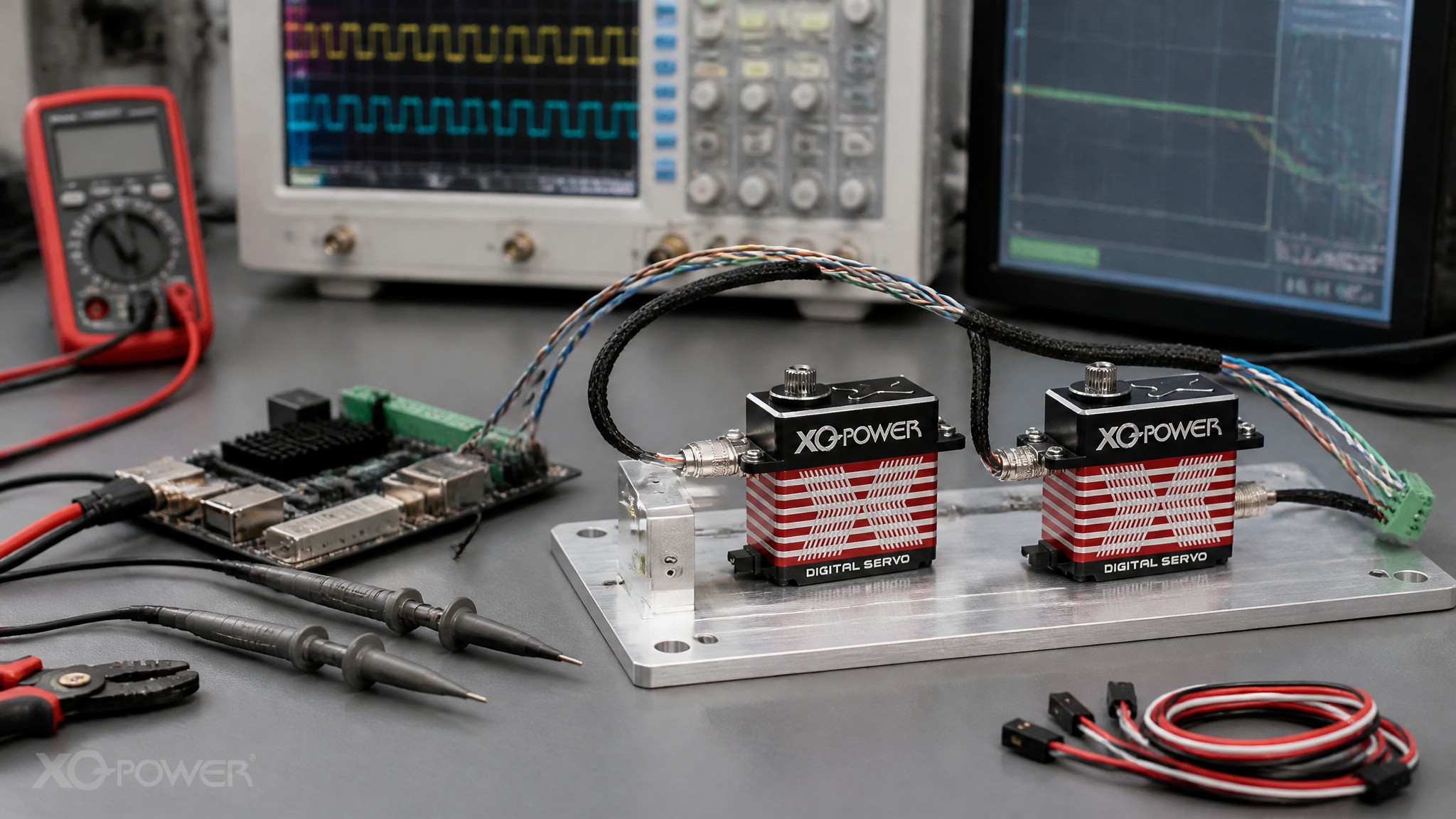
Acceptance criteria should define the measurement instrument, sampling method, number of repetitions, payload, direction, temperature, and statistical method. If the target is for high-precision placement, the customer and engineering team should agree on the tolerance definition before testing.
Can XQ-POWER Support a Custom Vision-Positioning Project?
XQ-POWER states that its engineers can review application requirements such as torque, speed, voltage, size boundaries, communication protocol, and reliability. For a vision-guided gripping or placement project, add the camera setup, payload, tool-center-point tolerance, cycle time, axis count, encoder requirement, and calibration method to the inquiry.
The product solution may involve a standard closed-loop digital servo, a brushless servo with magnetic encoder feedback, a different gear or output configuration, or a custom OEM/ODM arrangement. Final repeatability must be confirmed using the actual integrated mechanism and not inferred from a product category label.
Frequently Asked Questions About Servo Repeatability and Vision Pick-and-Place
They can be considered for vision-guided gripping, automated loading and unloading, sorting, and robotic joints when the selected servo is matched to the load, speed, feedback, mounting, and repeatability requirements of the complete system.
No. A magnetic encoder can provide useful closed-loop position feedback, but final placement also depends on gear backlash, mechanical rigidity, shaft alignment, tool compliance, payload, temperature, controller tuning, and camera calibration.
Accuracy describes how close the achieved position is to the intended real-world coordinate. Repeatability describes how closely repeated moves return to one another. A system can be repeatable but offset from the correct coordinate if calibration is wrong.
It can provide more load capacity and reduce performance loss under a demanding load, but higher torque alone does not remove backlash, structural deflection, encoder limitations, or calibration error. The actuator must be matched to the full mechanical system.
Test no-load, reversal, loaded, workspace, thermal, and vision-calibration repeatability with the actual tool and payload. Define the measurement method, repetition count, temperature, approach direction, and acceptance tolerance before testing.
XQ-POWER can review requirements such as encoder configuration, gearing, voltage, communication, mechanical mounting, torque, speed, and duty cycle for an application-specific or OEM/ODM solution. The final target must be verified through integrated testing.
Conclusion
XQ-POWER closed-loop digital servos and brushless magnetic-encoder servos can support repeated positioning in vision-guided gripping, automated handling, sorting, and robotic-joint applications. Whether a system meets a high-precision pick-and-place target depends on the complete error budget.
Start with the target tolerance, then match encoder feedback, gearing, backlash, mechanical rigidity, output support, load, temperature, controller, and vision calibration. Validate the actual tool-center point through no-load, reversal, loaded, workspace, thermal, and calibration tests. This approach provides a more reliable engineering basis than selecting a servo from torque or encoder type alone.