
Last month, a Tier-1 automotive integrator approached us with a recurring failure: their high-speed pick-and-place robot arm was losing 1.2° of positioning accuracy every 48 hours. After dismantling the competitor’s 80 kg·cm servos, the culprit was clear—micro-deformation on the 7075 aluminum output gear. The teeth hadn’t snapped; they had “flowed” under the heat and pressure of repeated 2.5G acceleration cycles.
In the world of high-torque actuation, selecting the right gear metallurgy isn’t just about weight; it’s about the Fatigue Limit of the material under high-frequency impact.
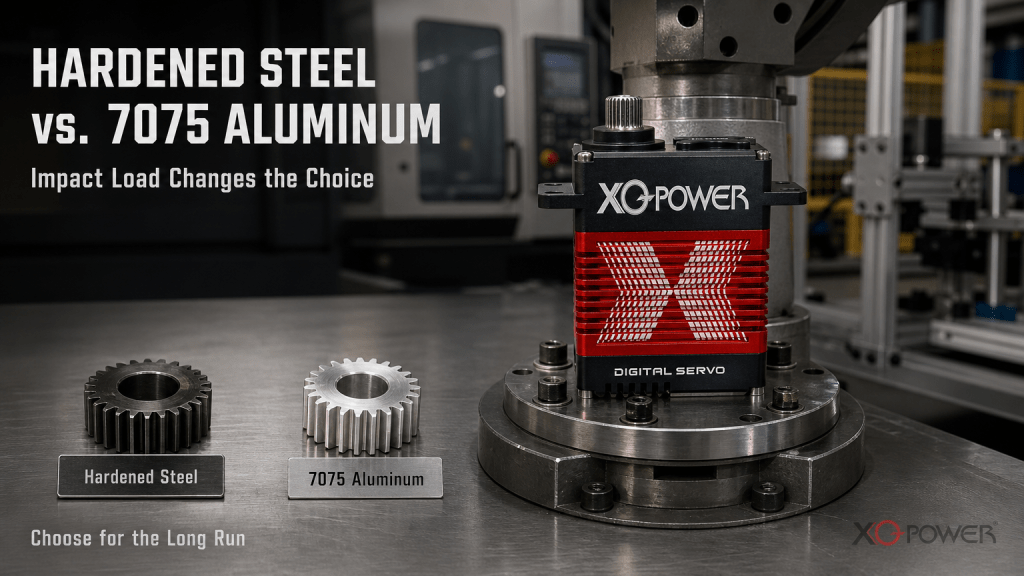
Direct Answer: Steel vs. Aluminum for Industrial Servos
Verdict for Engineers: For high-duty cycle applications exceeding 60 kg·cm of torque, Hardened Stainless Steel is the only reliable option. While 7075 Aluminum is excellent for weight-sensitive UAV gimbals or short-term prototypes, it lacks the surface hardness to withstand continuous impact loads. In XQ-POWER’s 2,000-hour industrial life test, steel gear trains show <0.05° of backlash growth, whereas aluminum gears often exceed 0.5° after just 400 hours.
1. The Physics of Surface Fatigue: Why Aluminum Fails at Scale
7075 Aluminum is often called “Aerospace grade,” which sounds impressive in a marketing brochure. However, in a gearbox, the primary stress is Hertzian Contact Stress.
When a servo hits a hard stop or reverses direction at high speed (Impact Load), the pressure on the gear tooth surface is immense. Aluminum has a specific “Fatigue Limit”—it will eventually deform even under loads it was rated to handle. Hardened Steel, conversely, has an endurance limit; if the stress stays below a certain threshold, the gear can theoretically run for millions of cycles without internal structural change.
2. Material Performance Matrix: Hardness vs. Durability
Below is the technical data comparing the three most common materials used in industrial actuators.
| Property | 7075 Aluminum | Brass / Copper | Hardened Stainless Steel |
|---|---|---|---|
| Surface Hardness (HRC) | ~15-20 | ~10-12 | 45 – 52 (Heat Treated) |
| Tensile Strength (MPa) | ~570 | ~350 | 1100+ |
| Fatigue Resistance | Low (Accumulative) | Moderate | High (Infinite Life Zone) |
| Impact Resilience | Deformation Prone | Brittle Snap | High Elasticity/Strength |
| Best Application | Weight-critical UAVs | Low-cost RC Toys | AGVs, Humanoids, Industrial Arms |
3. The XQPOWER Engineering Advantage: Full-Steel Gear Trains
At XQ-POWER, we design our high-torque series (like the S9750D or 9150D) with a single philosophy: Reliability over Weight Savings.
- Vacuum Heat Treatment: Our steel gears undergo vacuum quenching to achieve a consistent HRC 48 surface hardness while maintaining a tough, non-brittle core.
- Precision CNC Profiling: To prevent the “whining” noise associated with steel gears, we use high-precision CNC hobbing to ensure smooth engagement, reducing friction and heat buildup.
- LSI Integration: By using hardened steel, our magnetic encoder servos can maintain sub-degree precision across their entire service life, as there is zero physical play introduced by gear wear.
Frequently Asked Questions
A: We strongly advise against it for industrial use. At 100 kg·cm, the point-load on the teeth exceeds the yield strength of aluminum, leading to rapid backlash growth or total tooth failure under impact.
A: No. Plating is a surface coating (often for aesthetics or corrosion). It does not change the core material’s strength. A plated aluminum gear still has an aluminum core that will deform under high load.
A: Gear wear is the #1 cause of failure in long-term reliability tests. Servos using hardened steel gears can pass the 2,000-hour mark with negligible changes in accuracy, whereas softer materials fail due to gear-mesh gap increases.
Conclusion: Choosing for the Long Run
In the race for “the cheapest servo,” materials are the first thing cut. But in the world of industrial automation, a gear failure is a production line failure. Investing in hardened steel gear actuators ensures that your system’s precision on Day 1 is the same precision you see on Day 500.
Explore XQ-POWER’s High-Torque Steel Series: