
Magnetic Encoder vs Potentiometer Servo: Stop Recalibrating Your Machines
The magnetic encoder vs potentiometer servo debate comes down to one question: how often do you want to recalibrate? “Our potentiometer servos drifted 0.8 degrees every six months. The magnetic encoder replacements still hold 0.05 degrees after two years with zero recalibration,” one packaging line engineer told us. In other words, the feedback sensor is the servo’s memory. If it degrades, the machine forgets where it is.
The Potentiometer Wear Problem
A potentiometer uses a wiper sliding on a resistive track. Every movement scrapes material off the track. After roughly 50,000 cycles, the center region resistance shifts 5 to 10 percent. Consequently, the voltage reading drifts. The control board sees a false position error and hunts to correct it. Meanwhile, contact oxidation adds noise. As a result, the servo jitters. For machines that spend most of their time near neutral — conveyor gates, valve actuators — this degradation accelerates.
How Magnetic Encoders Eliminate Drift
A magnetic encoder has no contact. A magnet on the shaft spins past a Hall sensor array on the PCB. The sensor reads field angle, not field strength. Therefore, there is no wear path. No dead spots. No oxidation. Specifically, position accuracy stays within 0.05 degrees across millions of cycles. For industrial automation running 24/7, the magnetic encoder vs potentiometer servo decision determines whether you schedule recalibration or forget about it entirely.
S9150D: Tested to 100,000 Cycles
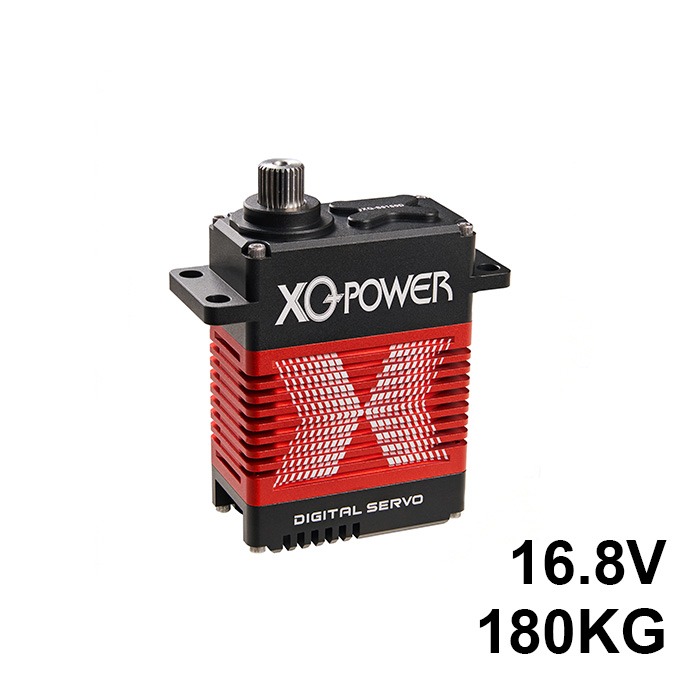
The XQ-Power S9150D uses a 12-bit magnetic encoder at 333Hz closed-loop. In accelerated testing across 100,000 full-sweep cycles, it held 0.05-degree accuracy. By comparison, a potentiometer servo of equivalent torque drifted to 0.7 degrees in the same test. For a valve actuator cycling 200 times per day, that’s recalibration every 8 months versus never.
Finally, potentiometers still have a place for low-cycle hobby use where cost matters more than accuracy. However, in any industrial application where position is a process requirement, the encoder price difference is cheaper than one scrapped batch.1