
Brushless vs Brushed Servo Cost: Why the Cheaper Motor Costs More
The brushless vs brushed servo cost comparison starts with purchase price but ends with total ownership math that makes the cheaper motor look expensive — a packaging line manager once showed me two purchase orders side by side. A brushed DC servo motor for the conveyor indexing station: $85. The brushless replacement his team was evaluating: $210. He pointed at the price difference and asked “why would I pay 2.5x more for the same torque?” The answer took about 30 seconds: the brushed motor ran 16 hours a day, needed new brushes every 4 months at $35 per set plus 45 minutes of technician time, and cooked its commutator after roughly 18 months of continuous operation. The brushless motor had zero wear items and an expected service life of 20,000+ hours. The brushless vs brushed servo cost comparison isn’t about the purchase order. It’s about what happens over the next three years.
1
Brushes are the fundamental weakness. In a brushed DC servo, carbon brushes press against a rotating copper commutator to deliver current to the rotor windings. Every rotation involves sliding friction, electrical arcing at the brush-commutator interface, and gradual erosion of both the brushes and the commutator segments. The brush dust — a fine conductive carbon powder — accumulates inside the motor housing and can eventually short adjacent commutator segments or contaminate the bearings. In a cleanroom application, that dust alone disqualifies brushed motors.
2
Maintenance cost is the most visible line item in the brushless vs brushed servo cost equation. A brushed servo running 8,000 hours per year in an industrial environment needs brush inspection every 1,000 to 2,000 hours and brush replacement every 3,000 to 5,000 hours depending on load and speed. That’s two to eight maintenance events per year, each requiring a technician to access the motor, remove the brush caps or open the housing, inspect, and reassemble. At a fully burdened technician cost of $75 per hour and 45 minutes per inspection, you’re spending $450 to $1,200 per servo per year just on preventive maintenance. A brushless servo needs zero maintenance events. Zero.
3
Energy efficiency tilts further toward brushless. Brushed motors lose 5% to 15% of input power to brush friction and commutator resistance. Brushless motors, with electronic commutation and no sliding contacts, typically achieve 85% to 92% efficiency. For a 200-watt servo running 8,000 hours per year at $0.12 per kilowatt-hour, that 10% efficiency gap translates to roughly $19 per year in electricity. Over a 10-year installation life, that’s $190 per servo — nearly the purchase price of the cheaper brushed unit.
4
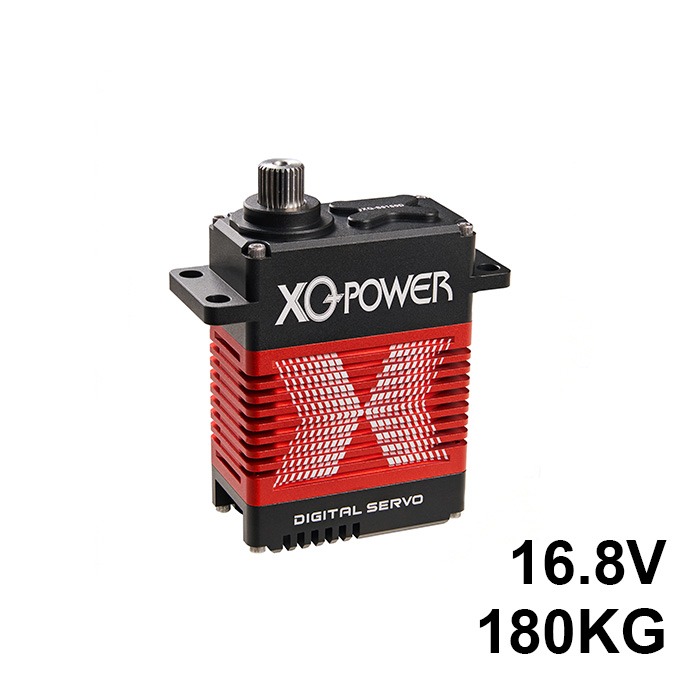
Service life is where the comparison becomes lopsided. A well-maintained brushed servo under moderate load might last 5,000 to 10,000 hours before the commutator wears beyond spec. A brushless servo under the same conditions routinely exceeds 20,000 hours, and magnet-grade industrial units like the XQ-Power S9150D are rated for 30,000+ hours. In a 24/7 production environment — 8,760 hours per year — the brushed motor is an annual replacement item. The brushless motor lasts three to five years. When you factor in replacement motor cost plus the production downtime to swap it, the brushless vs brushed servo cost math isn’t even close.
The one scenario where brushed still makes sense: intermittent low-duty applications where the motor runs a few minutes per day. A test fixture that actuates ten times during a shift, a calibration stand that runs during weekly maintenance, a lab prototype that might get redesigned in three months. In these cases, the maintenance interval stretches to years and the efficiency difference is negligible. For anything that runs more than 1,000 hours per year, brushless pays for itself within the first 12 to 18 months.