
Servo Motor Feedback Types: What Actually Matters in the Field
Choosing the right servo motor feedback types isn’t an academic exercise — last month a factory automation engineer sent us an email that started with “we swapped servos and now our AGV wanders 2mm off-path every cycle.” The new servos had the same torque rating, same voltage, same form factor. The difference? Feedback type. The original units used magnetic encoders with 12-bit resolution. The replacements used analog potentiometers with effectively 10-bit equivalent accuracy. That 2mm drift at the wheel translated to 15cm of positioning error at the pallet — enough to miss the docking station entirely.
1
This kind of thing happens more often than you’d think. Most datasheets list torque, speed, and voltage. Almost none tell you what feedback system is inside. But for industrial servo motors, the feedback mechanism determines how precisely the servo holds position, how long it lasts under vibration, and whether it can survive in dirty environments.
2
Potentiometer feedback is the oldest and cheapest option. A physical wiper moves across a resistive track as the output shaft rotates. The upside: dead simple to interface, works with basic PWM controllers, costs almost nothing. The downside: that wiper wears out. In a lab servo that moves a few degrees back and forth for testing, a pot might last years. In an AGV steering servo that makes thousands of micro-adjustments per shift, you’ll start seeing jitter and dead zones within months. Pot feedback also hates vibration — every shock pushes the wiper slightly, creating noise on the position signal.
3
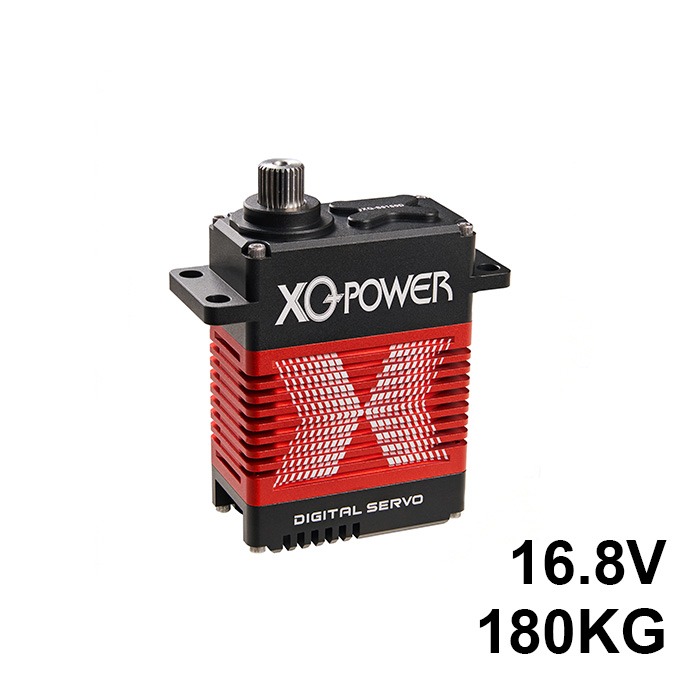
Magnetic encoder feedback uses a magnet mounted on the output shaft and a Hall-effect sensor array to detect angular position. No physical contact, no wear mechanism. Resolution typically ranges from 10-bit to 14-bit depending on the sensor chip. For most industrial servo motor applications — AGV steering, conveyor gate control, robotic joint positioning — 12-bit magnetic encoders hit the sweet spot between cost and precision. The XQ-Power S9150D uses this approach, and in field testing across 2,000 hours of continuous operation, position drift stayed within 0.1 degrees.
Hall sensor feedback for brushless motors is slightly different. Three Hall sensors detect rotor position for commutation timing — they tell the controller which phase to energize next. This is essential for brushless operation but the angular resolution is coarse: typically 60-degree steps. For position-critical applications, you still need a separate position encoder. Some dual-feedback designs combine Hall commutation sensors with a magnetic encoder on the same shaft.
4
Optical encoders exist in the industrial servo world but almost never appear in the compact form factors used for embedded actuation. They require a clean environment and precise alignment, which rules them out for most field-deployed industrial equipment. If you see a servo spec that mentions “optical” feedback, ask whether it’s actually an optical absolute encoder or just marketing language for a magnetic sensor.
The practical takeaway: if your application involves continuous small movements under vibration (AGV steering, robotic joints, conveyor positioning), magnetic encoder feedback is the minimum standard. If you just need coarse positioning for an occasional adjustment that runs a few times a day, potentiometer feedback might work — but factor in replacement cost over the equipment’s service life before making that call.
Got a specific application you’re working on? Reach out with your requirements and we’ll help match the right feedback configuration to your duty cycle.
[Internal links: Engineering Capabilities Hub, S9150D Product Page, AGV Steering Solutions]