
Stop Building, Start Integrating: Why Aircraft Actuators Demand Servos, Not Just Motors
In technical discussions, people often use the terms “motor” and “servo” interchangeably. If you’re building a simple toy, that’s fine. But if you’re designing an aircraft actuator system or a tactical UAV, confusing the two is a recipe for project failure.
At its core, a motor is just a component. A servo, however, is a closed-loop solution.
When we talk about high power density in the aerospace context, we aren’t just talking about raw RPM. We’re talking about controlled, reliable, and intelligent movement. Here is why high-end engineering is moving away from DIY motor-ESC assemblies toward integrated high-torque servos.
1. The Intelligence of the Feedback Loop
A motor spins when you give it power. It doesn’t know where it is, how fast it’s going, or if it has hit an obstacle. In an aircraft actuator system, this lack of “self-awareness” is dangerous.
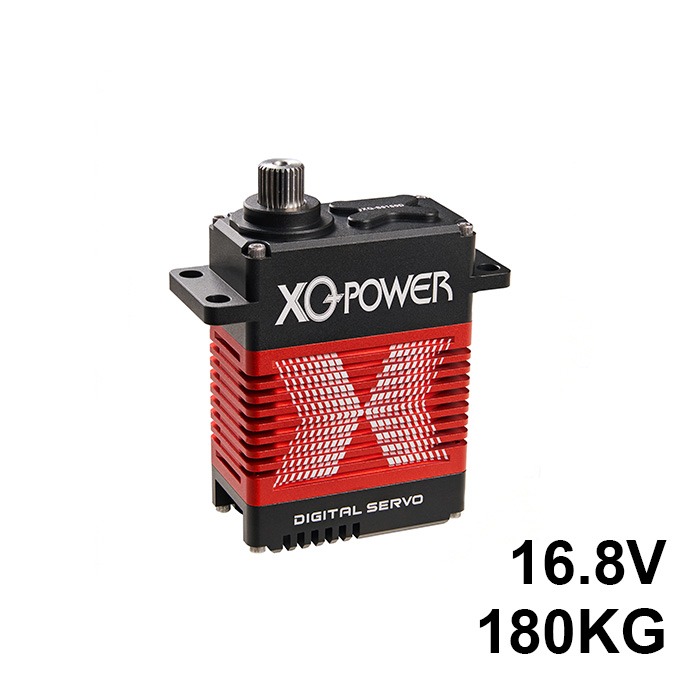
An XQ Power heavy-duty servo integrates a high-resolution potentiometer or magnetic encoder. It constantly communicates with the controller, ensuring the control surface (like an aileron or a heavy-payload drop mechanism) is exactly where it needs to be, down to the degree. This isn’t just “power”; it’s telemetry.
2. Integrated Gear Reduction: The Torque Secret
Many engineers try to take a high-speed brushless motor and attach a separate gearbox to gain torque. This usually results in a bulky, inefficient “Frankenstein” actuator that’s prone to failure at the coupling.
A true high-power-density servo is designed as a single unit. The CNC-machined steel gears are aligned with micron-level precision inside the housing. By integrating the reduction gearset directly into the servo, we achieve a much higher torque-to-weight ratio—critical for UAVs where every gram counts.
3. Thermal Management in Tight Spaces
A bare motor generates heat that is difficult to dissipate if it’s tucked away inside a wing or a fuselage. Our servos use the CNC-machined aluminum middle case as a massive heat sink. Because the control circuit (the “brain”) is inside the same housing, it can monitor its own temperature and protect the system before a burnout occurs.
You don’t get that “self-preservation” logic with a basic motor and a separate ESC.
4. The “Reddit Trap”: Why DIY Actuators Cost More
On forums like Reddit or DIYDrones, you’ll see teams trying to save 100byusingagenericmotorandbuildingtheirownlinkageandhousing.Theyusuallyendupspending100byusingagenericmotorandbuildingtheirownlinkageandhousing.Theyusuallyendupspending500 in lost time and crashed hardware when the non-integrated system fails due to vibration or signal jitter.
For aircraft actuator systems, the risk is too high. An integrated servo like the XQ Power 91XX-series provides a plug-and-play reliability that “DIY motor kits” simply can’t match.
The Verdict
If your goal is just to “make something spin,” get a motor. If your goal is to move a precise load, hold it against wind resistance, and receive real-time status data, you need an integrated servo.
In the demanding world of aerospace and heavy-duty robotics, integration isn’t a luxury—it’s the baseline for survival.