
Servo Heat Dissipation: Why CNC Aluminum Housing Matters
I was scrolling through a Reddit thread on r/robotics yesterday, where a developer was complaining about his bipedal robot “losing its balance” after 20 minutes. Most comments suggested checking the PID gains, but the culprit was much simpler: Servo Heat Dissipation. As his high-torque servos heated up, their internal resistance spiked, causing a massive drop in output power. If you’ve ever noticed your robot getting “lazy” during a long session, you’re likely dealing with thermal torque decay.
1. How Servo Heat Dissipation Affects Your Torque
When we talk about servo heat dissipation, we aren’t just talking about a warm case; we’re talking about the physics of copper and magnets. As the internal temperature of a motor rises, the electrical resistance of the copper windings increases. According to Ohm’s Law, this means at a constant voltage, less current can flow.
Less current = Less torque.
If your housing can’t move that heat to the outside air fast enough, your “50kg” servo effectively becomes a 35kg servo within minutes. This is why we prioritize long-term reliability testing—to see exactly when that power drop-off happens.
2. Material Conductivity and Servo Heat Dissipation
To solve the servo heat dissipation problem, you have to look at the thermal conductivity of the materials used in the housing.
| Material | Thermal Conductivity (W/m·K) | Performance Impact |
|---|---|---|
| Plastic (PA66) | ~0.25 | Acts as an insulator; traps heat. |
| Die-Cast Zinc | ~110 | Decent, but porosity limits heat flow. |
| CNC Aluminum 7075 | ~130 – 160 | Efficient “heat highway” to the surface. |
In our lab tests, swapping a plastic mid-case for a CNC-machined aluminum shell reduced internal core temperatures by 18°C under a sustained 75% load.
3. Why CNC Precision is Crucial for Cooling
Many low-cost suppliers use die-casting to save money. However, die-casting often leaves microscopic air pockets within the metal. Air is a terrible conductor. CNC Machining ensures a solid, dense grain structure that allows for uninterrupted heat transfer.
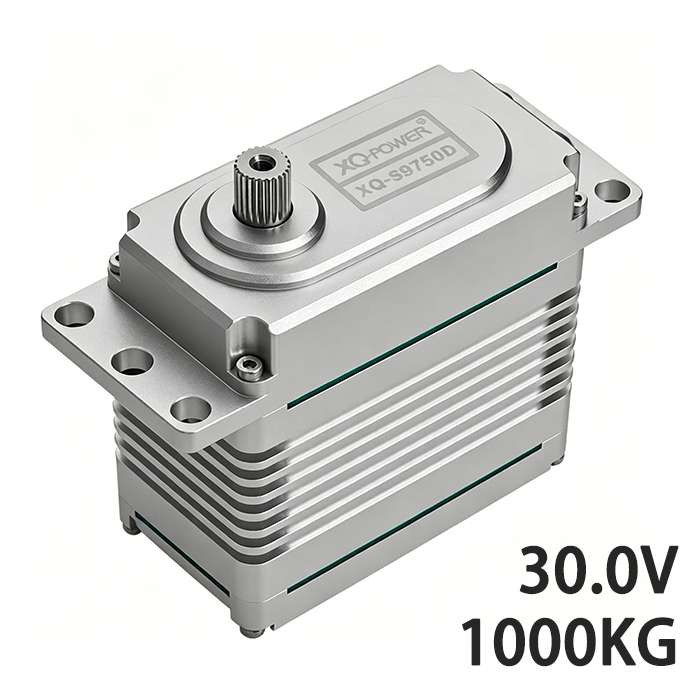
Furthermore, we maintain a machining tolerance of ±0.005mm. Why does this matter for servo heat dissipation? Because it allows the motor to sit flush against the aluminum wall. This “metal-to-metal” contact ensures the entire case acts as a massive heatsink, rather than having a tiny air gap that traps heat inside.
4. Engineering for the Real World
Whether you are building a UAV dropping mechanism that needs to hold a heavy payload or an industrial gripper, heat is your silent enemy.
At XQ-Power, we don’t just add “fins” to our cases for the look; we calculate the surface area required to ensure natural convection can keep the electronics stable. If your project demands constant, high-torque output, choosing a servo with a full CNC aluminum housing isn’t a luxury—it’s a technical necessity to prevent “power fading” in the field.
Powering Innovation
Contact XQ-power’s product specialist to recommend suitable motor or servo for your product.