
Why Your 1000kg Torque Servo Fails After 20 Minutes (The “Peak Torque” Trap)
I was browsing r/robotics the other day and came across a post by a guy (u/MotorBurner) who was losing his mind. He had designed a heavy-duty robotic joint using a high-torque servo. On paper, the torque was more than enough. But here’s the kicker: after running for about 20 minutes, the servo would get scorching hot, the torque would drop by 40%, and the system would start throwing “Positioning Errors.”
His first instinct? “I need a bigger motor.”
Actually, I’ve seen this exact mistake at dozens of factories. The problem isn’t that the motor is “too small”—the problem is that he fell for the “Big Number on the Box.”

The Dirty Secret of “Max Torque” Ratings
In the B2B world, especially when dealing with heavy-duty servos (like 500kg or 1000kg), manufacturers love to scream about Peak Torque.
Peak torque is essentially a “sprint” number. It’s what the motor can do for maybe 2 to 5 seconds before the internal coils start cooking. If your application involves a heavy-duty arm holding a 1-ton load for minutes at a time, Peak Torque is a useless metric. You need to look at Continuous Torque (Rated Torque).
Most engineers ignore the Duty Cycle. If you’re running at 80% load with a 100% duty cycle, your servo isn’t an actuator anymore—it’s an expensive space heater.
Why the Torque “Fades”
When a servo overheats, two things happen that kill your precision:
- Magnetic Flux Loss: As the permanent magnets in the rotor heat up, their magnetic field strength actually weakens. This is called “thermal demagnetization.” You’re pumping the same current, but getting less force.
- Internal Resistance: Heat increases the electrical resistance of the copper windings. The driver has to work harder, generating even more heat. It’s a death spiral.
How to Truly Select a Heavy-Duty Servo
If you are currently in the selection phase for a 1000kg torque application, stop looking at the top-line number. Do this instead:
- Check the Thermal Dissipation Profile: Does the motor have a large surface area for cooling? Does it use high-grade NdFeB magnets that can handle 150°C without losing flux?
- The “Rule of 70%”: For industrial automation that runs 24/7, I always suggest my clients calculate their load based on 70% of the motor’s Continuous rating, not the Peak. It leaves room for ambient temperature spikes in the warehouse.
- Encoder Stability: Heat doesn’t just kill torque; it kills accuracy. Cheap encoders drift when the motor casing hits 80°C.
The XQ-Power Approach
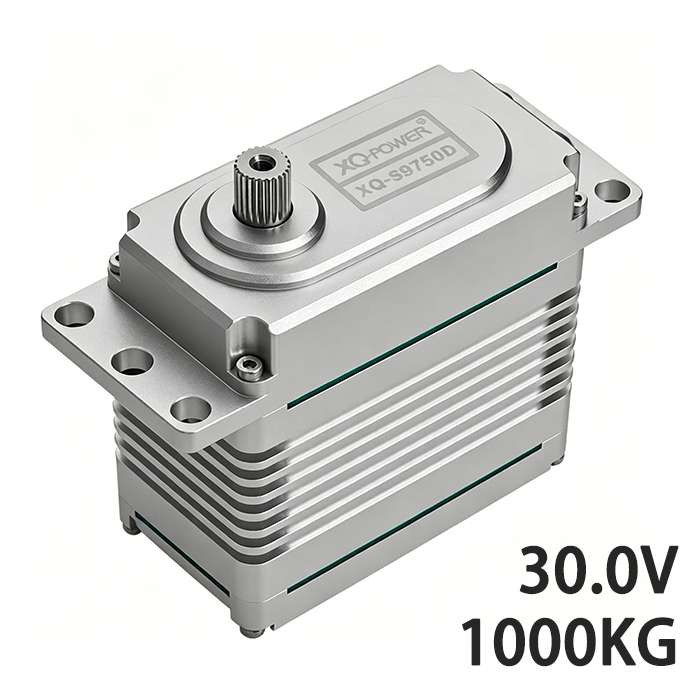
When we were designing the S9750D (1000kg Torque Servo), we didn’t just try to make it “stronger.” We focused on the Thermal Curve. We optimized the aluminum housing to act as a massive heat sink and used custom-wound coils with a higher thermal threshold.
I’m not saying the S9750D is the only choice, but it’s designed for engineers who are tired of torque fade. If you’re building something that needs to stay cool under a 1-ton load, take a look at our thermal test data. It might save you from the same headache u/MotorBurner had.
Powering Innovation
Contact XQ-power’s product specialist to recommend suitable motor or servo for your product.