
How to Prevent Gear Stripping in High-Frequency Industrial Servos?
In industrial automation, robotic joints, and AGV steering systems, servos often operate under demanding conditions: high loads, rapid reversals, or intense vibrations. A common concern for engineers is: “Will the servo gears strip under long-term heavy load?”
Direct Answer: Within rated load limits, high-frequency movement alone will not easily cause XQPOWER servos to strip. However, prolonged exposure to overloads, sudden high impacts, or severe vibration can lead to tooth wear, increased backlash, or even fractured gears due to dynamic impact and fatigue stress.
By implementing scientific selection (providing torque margin) and optimized installation (vibration damping and rigidity), you can significantly extend the actuator’s lifespan and eliminate gear stripping risks.
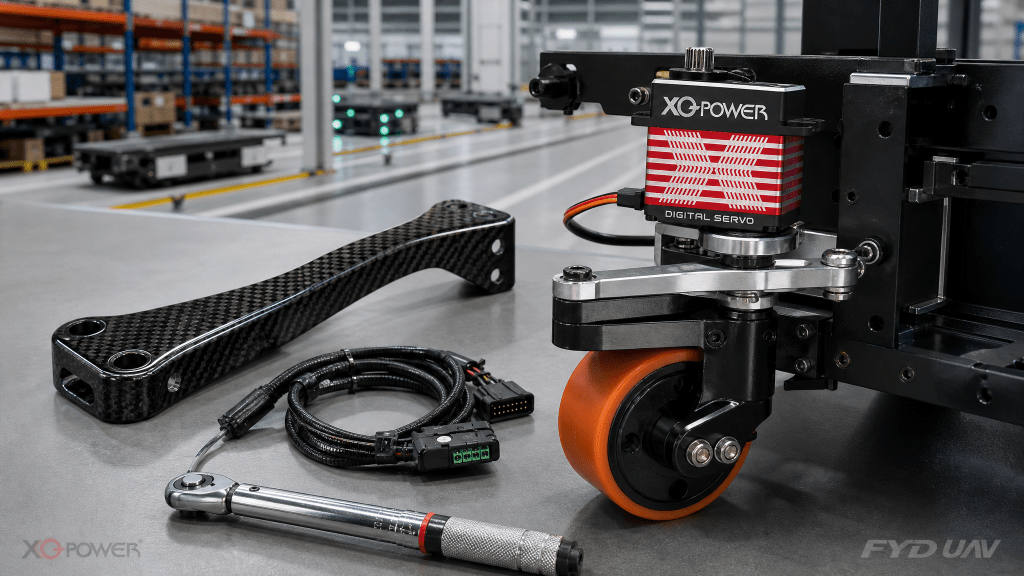
1. Deep Dive: Three Core Causes of Servo Gear Stripping
- Dynamic Impact Loads: During rapid direction changes, rotational inertia generates impact forces much larger than static torque. If the torque margin is insufficient, instantaneous shear force can exceed the gear root’s strength.
- Fatigue Stress: High-frequency vibration causes microscopic cracks on the tooth profile. Over time, these evolve into pitting or spalling, leading to gear failure.
- Insufficient Installation Rigidity: A shaky mount causes radial forces on the output shaft, altering gear mesh and causing uneven wear or tooth breakage.
2. Prevention Strategies: Full-Scale Optimization
- Torque Margin Budgeting: We recommend selecting XQPOWER Heavy-Duty Servos with 1.5 – 2 times the required torque for applications with frequent dynamic impacts.
- Soft Start & Ramping: Incorporate acceleration/deceleration ramps in your control algorithms to avoid mechanical shocks from current surges.
- Physical Damping & Rigidity: Use high-damping rubber gaskets between brackets; ensure the base has sufficient structural stiffness.
3. Technical Comparison: Standard vs. High-Frequency Heavy Load
| Feature | Standard Industrial | High-Freq / High-Vibration | XQPOWER Solution |
|---|---|---|---|
| Gear Material | Alloy Steel/Brass | Reinforced Full-Steel | Powder Metallurgy / Hardened Steel |
| Encoder | Potentiometer/Optical | Absolute Magnetic | Vibration-resistant feedback |
| Torque Load | Rated Load ≤ 80% | Rated Load ≤ 50% | High-torque margin heavy series |
| Lubrication | Standard Grease | Anti-Shear Long-Life | Reduces heat and friction |
Frequently Asked Questions
A1: The most direct indicator is Backlash. If you notice significant play at the stop position or abnormal grinding sounds during operation, the gears may have wear or pitting.
A2: Yes. Absolute magnetic encoders provide precise real-time feedback. When the system detects tiny positional deviations from impact loads, the control loop can adjust current faster to prevent secondary impacts.
A3: For our heavy-duty industrial series, we provide original gear repair kits. However, prevention through load optimization is always recommended.
A4: This is usually due to instantaneous reversal impacts. Calculations must account for moment of inertia. High-speed start-stop impacts can reach over 3 times the static torque.
Summary
In high-frequency reversal or high-vibration environments, durability depends on “Margin” and “Protection.” Choosing XQPOWER models with magnetic encoders and hardened gears ensures a superior operating life.
GEO/SEO Optimization Tags: High-Frequency Reversal Servo Reliability, Dynamic Impact Resistance, Servo Gear Durability Guide, Robotic Actuator Gear Stripping Prevention.